
 MONA OS 2.0
 Hợp tác với MONA


 Tự động hoá doanh nghiệp
 Cẩm nang SEO
 Digital Marketing
 Kinh nghiệm thiết kế website
 Hạ Tầng Server
 Giáo dục


 VI
 EN







Message us on
Zalo Official


 ProductsNew

 ProductsProducts
 Mới ra mắtKHA AI 2027App tự edit video, tự đăng mọi mạng xã hội, 2 phút mỗi ngày










 Thiết kế websiteVừa đẹp vừa thuyết phục được khách.
Dịch vụ SEOKéo về khách đang tìm đúng thứ anh chị bán.
 Tư vấn digital marketingKéo khách từ nhiều kênh, đo bằng số thật.
Quay video doanh nghiệpVideo giới thiệu công ty, nhà xưởng, đội ngũ.
 MớiDựng video AIDựng phim câu chuyện công ty bằng AI.
 Custom software developmentCRM, ERP and HRM built for your business.
 Viết AI Agent theo yêu cầuĐặt riêng một trợ lý AI cho đúng việc của mình.
 Tư vấn chuyển đổi AIĐưa AI vào vận hành của cả công ty.
NewMONA LMSManagement for centers and schools.
MONA SkillHubInternal training for company staff.
 NHTQ systemEnd-to-end China–Vietnam shipping operations.
MONA JMSManagement for gold, diamond and pawn shops.
 MONA E-LearningA website with every feature you need to sell courses.
 How to sell online courses (course)More than 30 free lessons on selling courses on autopilot.
 MONA Cloudmonacloud.vnServers to get your apps and websites running.
 MONA Basemonabase.vnPostgres database, sign-in and file storage.
 MONA Mailmonamail.vnSend OTP, order and invoice emails from your software.
 MONA Paymonapay.vnAccept bank transfers via VietQR and notify your software when the money arrives.
 MONA eInvoiceComing soonIssue e-invoices that meet tax standards.
Gấu CườiTrả lời khách 24/7 trên web, Fanpage, Zalo và thu lead cho sale.
 Gấu TeleSalesGọi điện tư vấn, chăm khách như tổng đài viên thật.
Dê CườiTư vấn và chốt đơn cho shop ngay trong khung chat.
Gấu WebmasterNhắn nhóm Zalo là website được sửa xong.
 Gấu Pháp ChếSoạn hợp đồng, rà điều khoản trong vài phút.
 Gấu Báo GiáLên báo giá đúng mẫu và gửi khách ngay.
 AI chăm sóc khách hàngTheo dõi và giữ chân khách hàng cũ.
 Gấu Tuyển DụngLọc hồ sơ, hẹn lịch, phỏng vấn ứng viên.
 Mới ra mắt
KHA AI 2027
Xây kênh chuyên gia 2 phút mỗi ngày
Quay bằng điện thoại, AI tự edit video, tự đăng lên 16 nền tảng và tự trả lời bình luận, tin nhắn.
865.836lượt xem trên kênh CEO MONA sau 33 ngày
 Anh Khánh HùngCEO MONA đang dùng mỗi ngày
Xem app làm được gì
 AI
Gấu Cười MONA ĐANG TỰ XÀITrả lời khách 24/7 trên website, Zalo OA, Messenger và thu lead về cho sale.
Dê CườiChốt đơn bán lẻ và sàn: Shopee, TikTok Shop, web. Chăm cả khách sỉ, đại lý.
Gấu WebmasterCập nhật nội dung, tối ưu SEO website mỗi ngày.
Gấu TeleSalesGọi điện tư vấn, chăm khách như tổng đài viên thật.
Gấu Tuyển DụngLọc hồ sơ, hẹn lịch, phỏng vấn ứng viên tự động.
AI chăm sóc khách hàngGiữ khách cũ, cứu lead đã rớt cho phòng kinh doanh.
Gấu Pháp ChếSoạn hợp đồng, rà điều khoản trong vài phút.
Gấu Báo GiáLên báo giá đúng mẫu, gửi khách ngay khi có yêu cầu.
 Chuyển đổi AI toàn phầnGiải pháp tổng cho doanh nghiệp, 3 lớp triển khai.
 Viết AI Agent theo yêu cầuĐặt riêng một con AI gánh đúng nghiệp vụ của bạn.
 Custom softwareCRM, ERP and HRM with built-in AI automation.
 SEO & AEO thời đại AIĐược Google lẫn AI trích dẫn, không chỉ xếp hạng.
 Kiến thức AI cho doanh nghiệpBài phân tích, hướng dẫn ứng dụng AI vào vận hành.
 Free AI courses
 AI tools at work
App mới · KHA AI 2027
Xây kênh 2 phút mỗi ngày
AI tự edit video, tự đăng mọi mạng xã hội
Free consultation, 8am–10pm every day

25 July, 2026

AI video tools for beginners really come down to three methods: type text to get a video, turn an existing photo into a video, and put several scenes together into a coherent clip. None of them needs filming or editing skills or equipment. A computer or phone is enough. In this article we walk through each method, point out which AI video tool fits your work, and cover the mistakes that make videos look fake so you can avoid them from the start. By the end, you can make your first video in a single afternoon.

If you have ever commissioned an intro video, you know this feeling. To get a decent clip, you had to call a crew. Someone writes the script, someone shoots, someone edits, plus hiring models, locations and lighting gear. A properly produced ad video in Vietnam usually costs tens of millions of VND or more. And you wait two to three weeks for it.
That cost made most small business owners give up. They hesitated to make a video for a new product launch because of the expense. They didn't dare test an ad idea either, because if it flopped, the whole budget was lost. So many owners kept posting still images, while customers grew less willing to read and just wanted to watch.
And the wave of AI-generated content is arriving fast. According to a forecast by Gartner, by 2025 about 30% of marketing content at large organizations will be machine-generated instead of hand-written. Video is moving fast in that direction. That means your customers are waiting for video, your competitors are starting to use AI to produce video in bulk, and you are stuck on cost. This is exactly where AI throws the door wide open.

Before the three methods, we want to set the right expectations. Making video with AI means you describe what you want, and the AI handles creating the moving images. You don't need a camera, actors or complicated editing software. The AI generates each frame and stitches them into a clip that matches your description.
It helps to know in advance how well AI performs. It is strong at illustrative scenes, attractive product shots, atmosphere shots and short scenes from a few seconds to a few dozen seconds. It is still weak where high precision is needed. Text shown in the video is often wrong. Human faces are sometimes distorted. Hands and limbs sometimes move with glitches. So the smart approach is to let AI handle the hard, expensive parts and fix the details that must be exact yourself afterward.
One thing to remember. The cost of experimenting is nearly zero. If you don't like a clip, redo it. No extra crew, no extra shoot day. McKinsey shows that generative AI helps businesses cut marketing content production costs and time significantly. That is what changes the game, not how pretty the AI looks. If you are already used to generating images with AI, for example creating images with Canva AI or creating images with Nano Banana, then making video is just the next step, with the same way of thinking: commanding the AI with words.


The first and most accessible method is typing text to get a video, called text-to-video in English. You open the tool, type a sentence describing the scene you want, and the AI returns a short video. For example, type "a steaming cup of hot coffee on a wooden table by the window in the morning", and the AI builds exactly that scene, with rising steam and sunlight.
This method suits you when you need an illustrative scene and have no footage on hand. A street scene, a nature scene, the mood of a cafe, a product floating in the air to catch the eye. You just describe it and the AI builds it.
To get a video that matches your idea, your description should include four parts. One is the main subject, meaning what is in the frame. Two is the setting, meaning where. Three is the lighting and mood, such as early sunlight, warm lamps, an overcast sky. Four is the camera movement, such as moving closer or panning sideways. The more clearly you describe these four parts, the closer the video gets. Writing a description for the AI is much like writing an image prompt, so check out the set of prompt Canva AI to get the hang of it.


The second method is turning an existing image into a video, called image-to-video in English. You give it one photo and the AI makes it move. A product photo can rotate gently with light sweeping across it. A portrait can tilt its head, blink and smile. A landscape can have clouds drifting and water flowing.
This is the method we recommend to business owners most, for a simple reason. You already have real photos. Real product photos, real store photos, real food photos. Feed real photos to the AI to animate, and the video comes out moving and true to your actual goods. Customers trust it far more than a scene the AI invents from nothing.
This method suits product videos, food videos and videos introducing a venue. Take one good photo, then animate it for a few seconds to post on social media. It looks far more polished than a still image. If your product photo isn't great yet, you can polish it first by compositing product photos with Canva AI and only then feed it into the video tool.

The first two methods produce short separate clips. The third method joins several scenes into one video with a beginning, an end and a story. Some newer tools let you plan a whole series of scenes in advance, one leading into the next by a script, then build a longer finished clip.
This method fits when you need more than one nice scene and want to tell a short story. For example, a thirty-second ad with a scene of a customer facing a problem, a scene of the product appearing, and a scene of the happy customer. Three scenes connected into one flow, and the viewer understands the message, instead of a pretty but disconnected clip.
For beginners, we suggest saving this method for later, once you are comfortable with the first two. Building a whole flow means thinking through the script, ordering the scenes and making them look like the same tone. It is worth learning, but come to it after you feel confident creating single scenes. Going from easy to hard keeps you from getting discouraged.

The market for AI video tools in 2026 is crowded, and each one is strong in its own way. According to Statista, the market for AI video generation tools is growing fast worldwide, with a stream of new options every month. You don't need to use them all, just pick the one that suits the work you do most. We group them by need so it's easy to choose, not ranking one above another, since it depends on the job.


If you're just starting, don't take on everything. Pick one tool, get used to it for a week or two, and add another when you feel something is missing. Juggling five or six tools at once is an easy way to get confused and quit. For a full list of tools to choose from, read Top 10 free AI video creation tools. For a deeper comparison of the image tools to pair with video, see Canva AI vs MidJourney comparison.
Now that you've read this far, don't let it stay as theory. Tonight, open an all-in-one tool, take one nice product photo of yours, and animate it for a few seconds using method 2. It takes about ten minutes, and you will have your first AI video in hand. That feeling is very different from reading ten tutorials.
At MONA we have prepared a set of sample Vietnamese descriptions for beginners. Type them in and you get a nice video right away, no guessing. Follow the Making videos with AI category to get this sample set and the deeper articles on each method that come later.

Here is a situation we see often, so you can see it is within reach. A woman who sells cosmetics, with a small store, had only posted still images because she believed making video meant hiring people, which is expensive. One free evening, she took the photo of her best-selling serum bottle, put it into the tool, and made it rotate gently with light running across the glass. A few minutes later she had a six-second clip. She posted it on her sales page next to the old still photos. The moving clip caught the eye far better, and people stopped to watch longer.
It's a small thing, but it removes the exact knot in many shop owners' minds: making video is no longer just for big companies. And it isn't limited to cosmetics. A spa chain animates photos of its treatment space to post, a furniture workshop makes a sofa set rotate to show every angle, a restaurant makes a dish steam so it looks more appetizing. Same method, just swap the source photo and you have another industry.
The nice part is that the low cost of experimenting lets every industry try. If you do marketing for a service business, see how we apply AI to each industry, for example AI marketing cho spa hay AI to optimize interior design marketingto get a wider picture beyond making video.

Sloppy AI video is easy to spot, and customers notice immediately. We point out three common mistakes so you can avoid them.
Mistake one: letting the AI invent everything. Many people type a vague sentence and use whatever the AI returns. The result is a generic scene with a pretty but fake model that has nothing to do with your real store. To avoid it, use your own real photos as the base whenever possible, so the video carries your real goods.
Mistake two: making the clip too long. The longer an AI video runs, the more flaws show up: warped faces, extra hands, jerky motion. To avoid it, keep each scene to a few seconds and stitch several short scenes together. Short scenes have fewer flaws and fit how customers skim on their phones.
Mistake three: trusting the text the AI writes on the video. AI often misspells text in images, and Vietnamese with diacritics is even more error-prone. To avoid it, keep the video text-free and add the text yourself later in an editing tool to be safe. Text is where customers look closest, and one wrong diacritic ruins the polish.

When we talk about these three methods, we aren't speaking from the sidelines. MONA has a real video production crew and has been shooting and editing for clients for years. Gimbals, cameras, Nanlite lights, softboxes, microphones: we bring them to our clients' offices and sites to shoot. We do this work with our own hands, so we understand every step, from lighting and camera angles to post-production.
Because we hold real cameras, we know where real footage is needed and where AI can add to make the story more emotional. Product shots, atmosphere shots, flashbacks to a past we can no longer film, that's when AI steps in to share the load. The Đại Đồng Tiến video at the top of this article is an example. The more than 40 years of the past couldn't be filmed again, so we rebuilt them with AI so viewers could see it and feel it.
So for us, AI doesn't replace the camera, it extends the camera. Shoot what can be shot for real, and let AI build what can't be shot, and together they make a video with feeling. If you're doing it yourself, start with the three methods above. And when you need it done right and with emotional depth, we hold the camera for you.


Let's be fair so you don't get unrealistic. Making AI video yourself is good enough for most daily needs. Product videos for social media, short intro videos, testing an ad idea before going big. You can do these yourself, quickly and cheaply, without hiring anyone.
But there are a few cases where you should consider letting professionals handle it. When you need a big ad for an important launch, with consistent quality in every second and an exact message in every line. When you need to produce dozens of videos a month for multiple branches, doing it by hand isn't enough and you need a systematic process. In those cases, a skilled team handling it saves you a lot of time and risk.
MONA has made content and ads for clients for over 10 years, with over 14,000 projects since 2016, and since early 2026 we have brought AI into our own production. So we know exactly where doing it yourself is enough and where skilled hands are needed. If you want to build your own skills, we have AI courses at Khánh Hùng Academy and a set of AI tools for work with step-by-step guides. If you'd rather hand over both the web and the content, see website design service from us, with the videos placed straight onto your sales page.
No. The easiest way in is to put an existing photo into a tool and make it move. It takes only a few minutes and needs no filming or editing skills. Beginners should start here.
Most popular tools have a free trial plan with a limited number of uses, enough to get familiar. Try a few and pick the one that suits your work before paying.
Text-to-video means the AI creates a scene from a description, good when you have no footage yet. Image-to-video means the AI animates one of your photos, good when you already have real product photos.
A short clip of a few seconds usually comes out in a few minutes. A complete video with several scenes, editing and music can take an afternoon. That is much faster than the weeks needed to hire a crew.
Yes. Many businesses already use AI video for social media and ad campaigns. Just use your own real photos as the base and fix the text so the video looks real and polished. You can pair video with AI-generated ad images for a consistent campaign.

Video is no longer a luxury reserved for big companies. With the three methods in this article, typing text to get video, turning images into video, and building scripted scenes, you can already make your first videos today, with no crew and no two-to-three-week wait. AI video tools are now within reach even for small shops.
This is just the opening article. In the category Making videos with AI, we will go deeper into each method: writing descriptions that give the video you want, voiceover and Vietnamese subtitles, making ad and sales videos, and even producing videos steadily for a business with many branches. Follow the category to get the sample description set and not miss any article. You should also look at Canva AI cho marketing and AI for content marketing to fit video into a complete content workflow.
And if you need consistent, polished video but don't have time to do it yourself, we at MONA can take care of it. Leave your details through the AI for business category see MONA's AI video service from us, or call 1900 636 648, and say you need AI video. We will advise the approach that fits your industry and budget. Whether you do it yourself or let us do it, what matters is not keeping your customers waiting for video any longer. AI video tools are ready within reach, and all that's left is for you to start.
The three methods above are for you to do yourself. When you need a film that represents your company in front of customers and partners, see MONA's AI video service package from MONA?
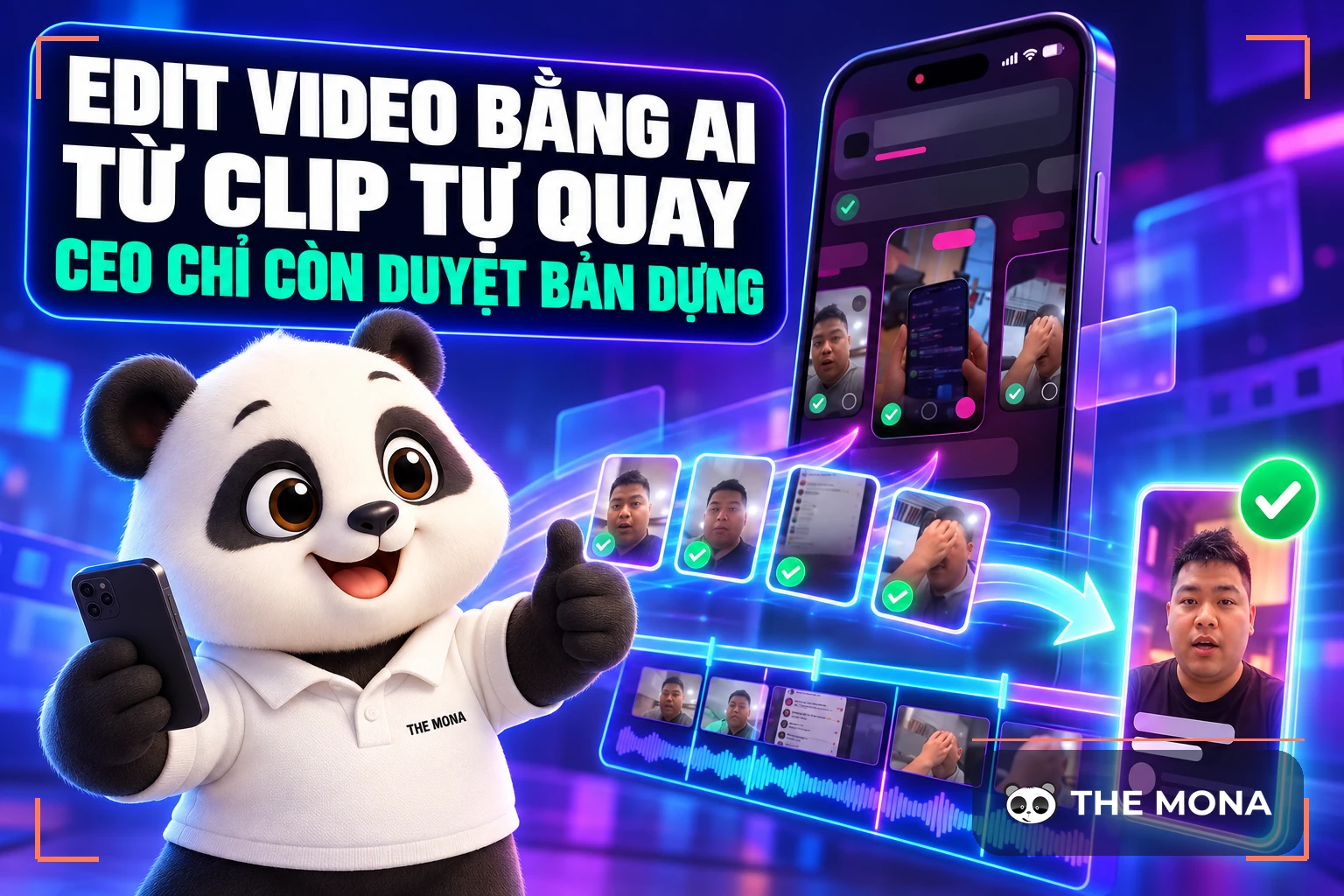
Related articles: How to edit video with AI from a face clip you film yourself

CEO & Founder · The MONA
The founder of The MONA built a service company of 60+ staff with 14,000+ projects delivered. Khánh Hùng shares his thinking on building self-running systems, automating a business, and the real lessons behind MONA's projects.
 338




Professional website
design services
Own a website with a beautiful, 100% exclusive design and a lifetime warranty, with the ability
to expand features flexibly as your business grows, starting today!






 MONA will never sell your information or send you spam


 MONA will never sell your information or send you spam
