
 MONA OS 2.0
 Partner with MONA


 Tự động hoá doanh nghiệp
 Cẩm nang SEO
 Digital Marketing
 Kinh nghiệm thiết kế website
 Hạ Tầng Server
 Giáo dục


 VI
 EN














Message us on
Zalo Official


 ProductsNew

 ProductsProducts
 Mới ra mắtKHA AI 2027App tự edit video, tự đăng mọi mạng xã hội, 2 phút mỗi ngày










 Website designLooks good and wins customers over.
SEO servicesBrings in customers searching for exactly what you sell.
 Tư vấn digital marketingKéo khách từ nhiều kênh, đo bằng số thật.
Corporate video productionVideos introducing your company, factory and team.
 NewAI video productionCompany story films made with AI.
 Custom software developmentCRM, ERP and HRM built for your business.
 Viết AI Agent theo yêu cầuĐặt riêng một trợ lý AI cho đúng việc của mình.
 Tư vấn chuyển đổi AIĐưa AI vào vận hành của cả công ty.
NewMONA LMSManagement for centers and schools.
MONA SkillHubInternal training for company staff.
 NHTQ systemEnd-to-end China–Vietnam shipping operations.
MONA JMSManagement for gold, diamond and pawn shops.
 MONA E-LearningA website with every feature you need to sell courses.
 How to sell online courses (course)More than 30 free lessons on selling courses on autopilot.
 MONA Cloudmonacloud.vnServers to get your apps and websites running.
 MONA Basemonabase.vnPostgres database, sign-in and file storage.
 MONA Mailmonamail.vnSend OTP, order and invoice emails from your software.
 MONA Paymonapay.vnAccept bank transfers via VietQR and notify your software when the money arrives.
 MONA eInvoiceComing soonIssue e-invoices that meet tax standards.
Gấu CườiTrả lời khách 24/7 trên web, Fanpage, Zalo và thu lead cho sale.
 Gấu TeleSalesGọi điện tư vấn, chăm khách như tổng đài viên thật.
Dê CườiTư vấn và chốt đơn cho shop ngay trong khung chat.
Gấu WebmasterNhắn nhóm Zalo là website được sửa xong.
 Gấu Pháp ChếSoạn hợp đồng, rà điều khoản trong vài phút.
 Gấu Báo GiáLên báo giá đúng mẫu và gửi khách ngay.
 AI chăm sóc khách hàngTheo dõi và giữ chân khách hàng cũ.
 Gấu Tuyển DụngLọc hồ sơ, hẹn lịch, phỏng vấn ứng viên.
 Mới ra mắt
KHA AI 2027
Xây kênh chuyên gia 2 phút mỗi ngày
Quay bằng điện thoại, AI tự edit video, tự đăng lên 16 nền tảng và tự trả lời bình luận, tin nhắn.
882.681lượt xem trên kênh CEO MONA sau 36 ngày
 Anh Khánh HùngCEO MONA đang dùng mỗi ngày
Xem app làm được gì
 AI
Gấu Cười MONA ĐANG TỰ XÀITrả lời khách 24/7 trên website, Zalo OA, Messenger và thu lead về cho sale.
Dê CườiChốt đơn bán lẻ và sàn: Shopee, TikTok Shop, web. Chăm cả khách sỉ, đại lý.
Gấu WebmasterCập nhật nội dung, tối ưu SEO website mỗi ngày.
Gấu TeleSalesGọi điện tư vấn, chăm khách như tổng đài viên thật.
Gấu Tuyển DụngLọc hồ sơ, hẹn lịch, phỏng vấn ứng viên tự động.
AI chăm sóc khách hàngGiữ khách cũ, cứu lead đã rớt cho phòng kinh doanh.
Gấu Pháp ChếSoạn hợp đồng, rà điều khoản trong vài phút.
Gấu Báo GiáLên báo giá đúng mẫu, gửi khách ngay khi có yêu cầu.
 Chuyển đổi AI toàn phầnGiải pháp tổng cho doanh nghiệp, 3 lớp triển khai.
 Viết AI Agent theo yêu cầuĐặt riêng một con AI gánh đúng nghiệp vụ của bạn.
 Custom softwareCRM, ERP and HRM with built-in AI automation.
 SEO & AEO thời đại AIĐược Google lẫn AI trích dẫn, không chỉ xếp hạng.
 Kiến thức AI cho doanh nghiệpBài phân tích, hướng dẫn ứng dụng AI vào vận hành.
 Free AI courses
 AI tools at work
App mới · KHA AI 2027
Xây kênh 2 phút mỗi ngày
AI tự edit video, tự đăng mọi mạng xã hội
Free consultation, 8am–10pm every day

02 June, 2026

We wrote this for shop owners who aren't technical and keep hearing people mention chatbot AI sales everywhere without picturing what it is. Put simply, a sales chatbot is software that automatically answers customer messages in place of your staff, connected to your fanpage, Zalo, website or marketplace store. MONA has built software since 2016, over 10 years, and every year customers come to us to build chatbots, so we share everything from real experience: there are 2 ways to build a chatbot, and each fits a different kind of problem. By the end, you will know which type suits your shop.
▶ Watch Dê Cười close real orders (13-minute video)
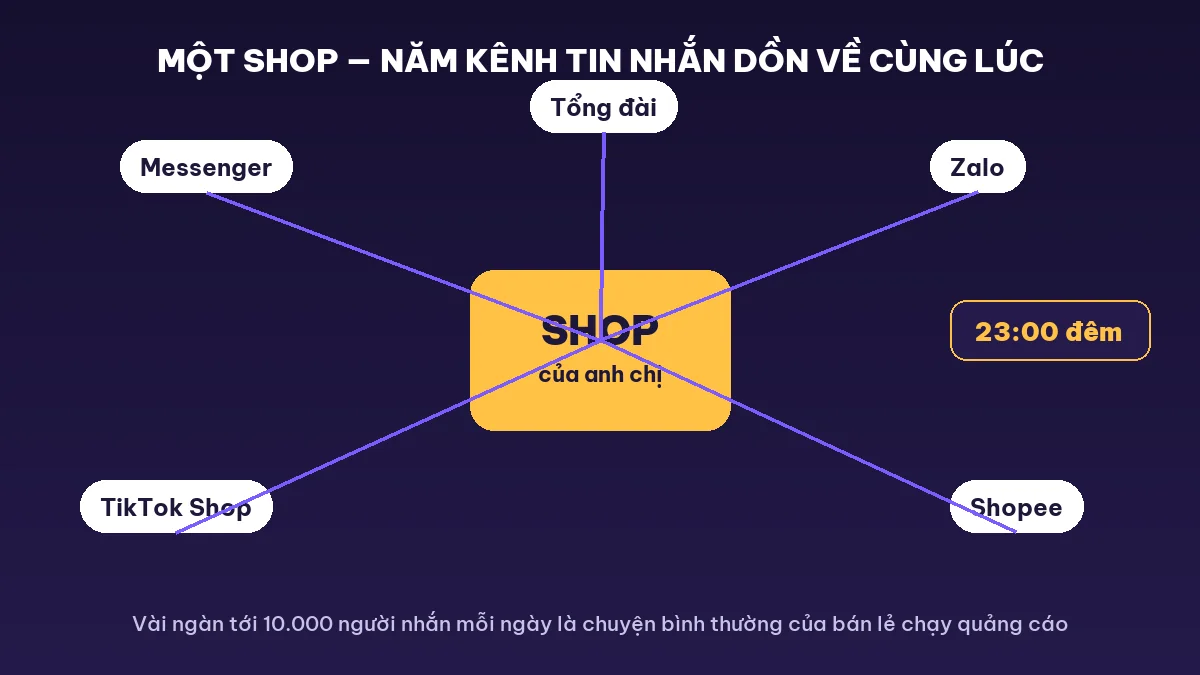
Picture a fashion shop running Facebook ads. At 11 pm, a customer lying in bed scrolling her phone sees a dress she loves and messages the fanpage to ask if size M is still available. The person on page duty is asleep by then, the message sits untouched until morning, and when they reply at 8 am she has already ordered a different dress from the shop next door at midnight. Every shop owner who sells online has tasted this. You don't lose the customer because staff are lazy, but because people have to sleep and customers don't.
The second issue is volume. For a retail shop running ads steadily, a few thousand messages a day is normal, and 10,000 is normal too, and that counts people, not the dozen messages each one sends. Some message on Messenger, some on Zalo, some ask on TikTok Shop, some on Shopee, and older customers call the hotline directly. Customers under 40 prefer texting to calling, so all that weight lands in the chat window.
The third issue is one few people notice: the person on page duty represents the whole brand. A customer messaging a fanpage doesn't think they are talking to one employee; they think they are talking to the entire company. Whoever sits in that seat must know the product, such as what fabric an item is, which size fits at a given height and weight, and also know the state of the business, such as which branch still has that model in size L. Together, these two things are already overwhelming.
And that's not all. The person on page duty usually also handles after-sales care: customers asking where their order is, complaining the goods arrived badly, asking to swap sizes. One person handling 200 to 300 customers a day can't serve everyone equally well, especially when a single chat drags on all day: the customer asks about a shirt in the morning, replies again in the early afternoon, and only pays by transfer late in the afternoon. This work is draining and truly stressful. Chatbots exist to take the load off exactly here.
The need for machines to answer fanpage and Zalo messages automatically is not a new fad. It has existed for about 20 years. MONA has been in the software business for over 10 years, and almost every year customers bring us exactly this request. The reason is simple: the page-duty role really matters, but hiring for it is hard, training is hard, and managing is even harder. Worldwide, running a call center and customer care is a profession of its own, with professional companies built on it. A retail shop that builds such a team itself takes on a whole area of operations that isn't its strength.
The first approach is the one the whole market has used for 20 years. MONA calls it the scripted chatbot, which many others call a rule-based chatbot. It gets that name because the whole bot is built on a decision tree that people write in advance. Think of a restaurant menu: if a dish is on the menu you can order it, and if it isn't, the kitchen won't cook it. A decision tree works the same way: a bot can answer a question that has been written, and for one that hasn't, it asks the customer to choose again or hands the chat to a person on duty.
For example, a fashion shop builds a simple tree: the customer opens the chat window and sees 3 buttons, View size chart, Track my order and Today's promotions. The customer taps Track my order, the bot asks for the order code, the customer types it, and the bot returns the delivery status. Each button is a branch with sub-branches under it, and the operator writes each answer for each branch and approves every word before it goes live.
Technically, this type runs on two classic programming techniques. The first is if-else, in plain terms “if this, then that” commands: if the customer taps button A, send the reply written for button A; if they tap button B, send the reply written for button B. The second is keyword matching, which programmers call pattern matching: the developer tells the machine in advance that if a message contains the word “size”, return the size chart, and if it contains “ship”, return the shipping fee. The machine doesn't need to understand the whole sentence, only to spot the words it was told to look for.
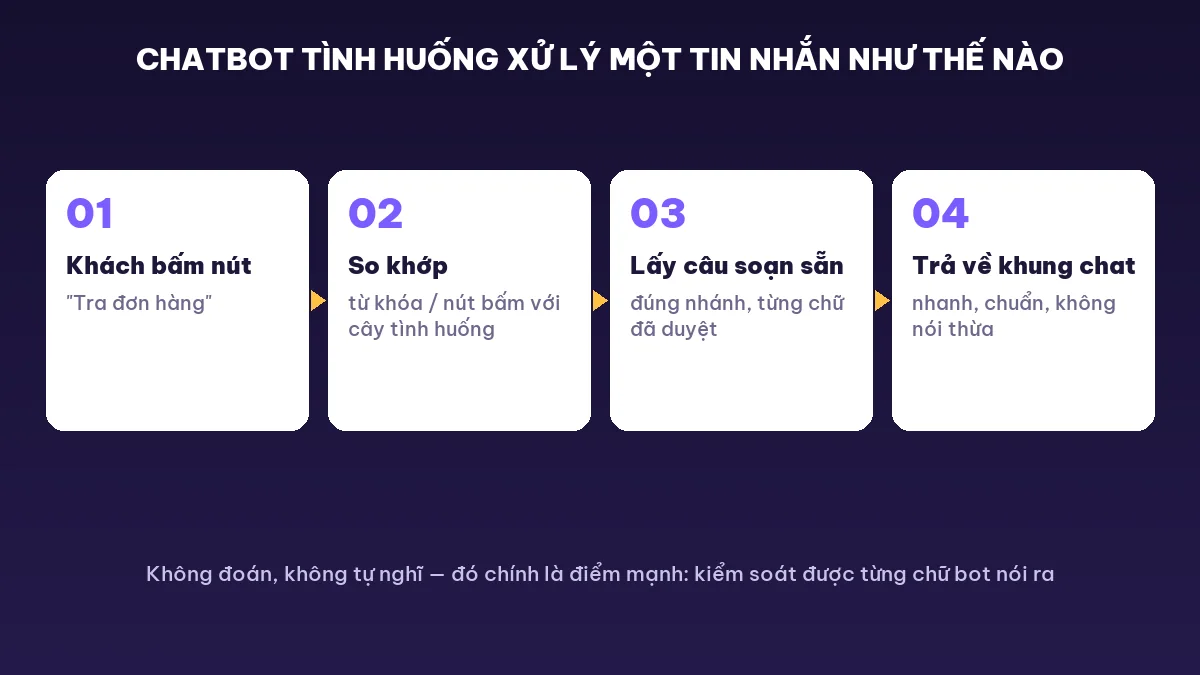
To make this clear, we describe the path of a message in words:
Notice one important point: across all 4 steps, the machine never makes up words. It doesn't guess and doesn't invent sentences. Every word the customer reads was written and approved by a person beforehand. That sounds like a weakness, but from an operations view it is the biggest strength of this type: the business fully controls every word sent out, and the bot never makes a promise the company didn't intend to make.
We have built software for over 10 years and met every kind of chatbot request, and to be fair, there are problems where the scripted type works so well that there is no reason to change. This section comes from real projects we delivered, not theory.
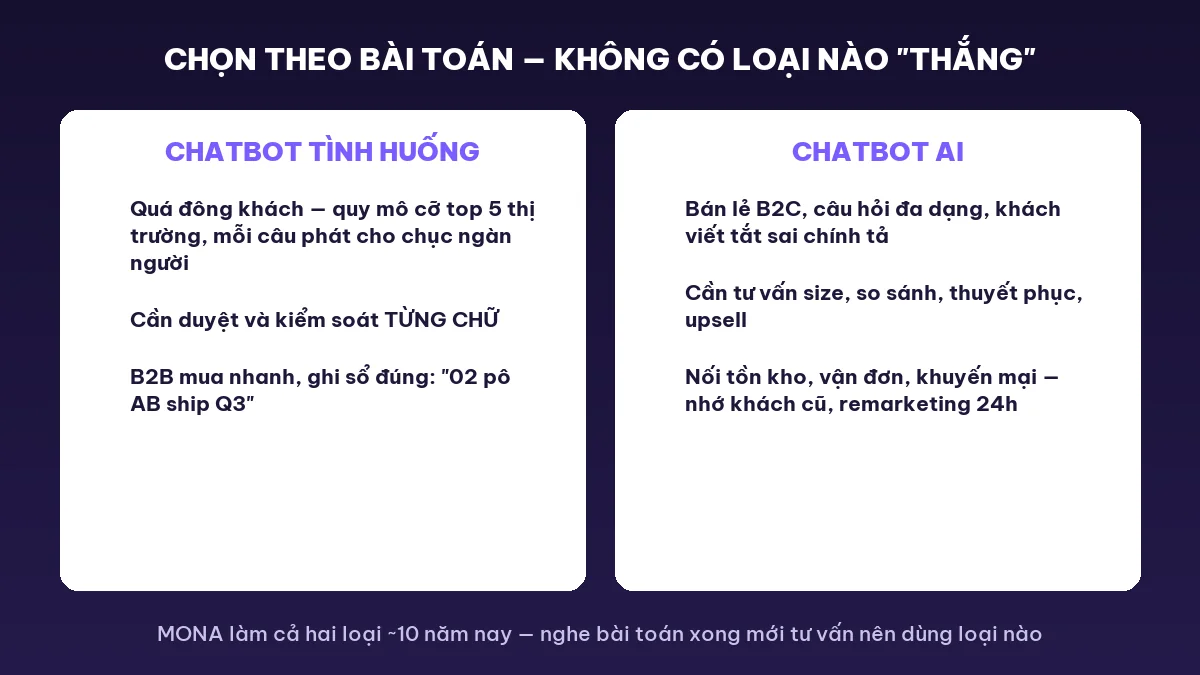
Picture a retail brand among the top 5 companies in all of Vietnam. Each reply the bot gives isn't said to one person; it goes out to tens of thousands of people a day. One badly worded sentence, and the next morning the screenshot is all over social media and the communications team spends weeks cleaning up. At that scale, a business needs a system where legal and communications can approve every word before it runs. A prewritten decision tree gives exactly that control: the machine only sends lines that a person has approved.
In some industries one wrong word becomes a big problem: prices, warranty policy, delivery commitments, promotion conditions. A business would rather have a bot that answers briefly and stiffly than one that words things on its own and slips up. For this need, lines written and approved by people are the safe choice: a customer asks today, another asks next month, and the answer stays identical down to the comma.
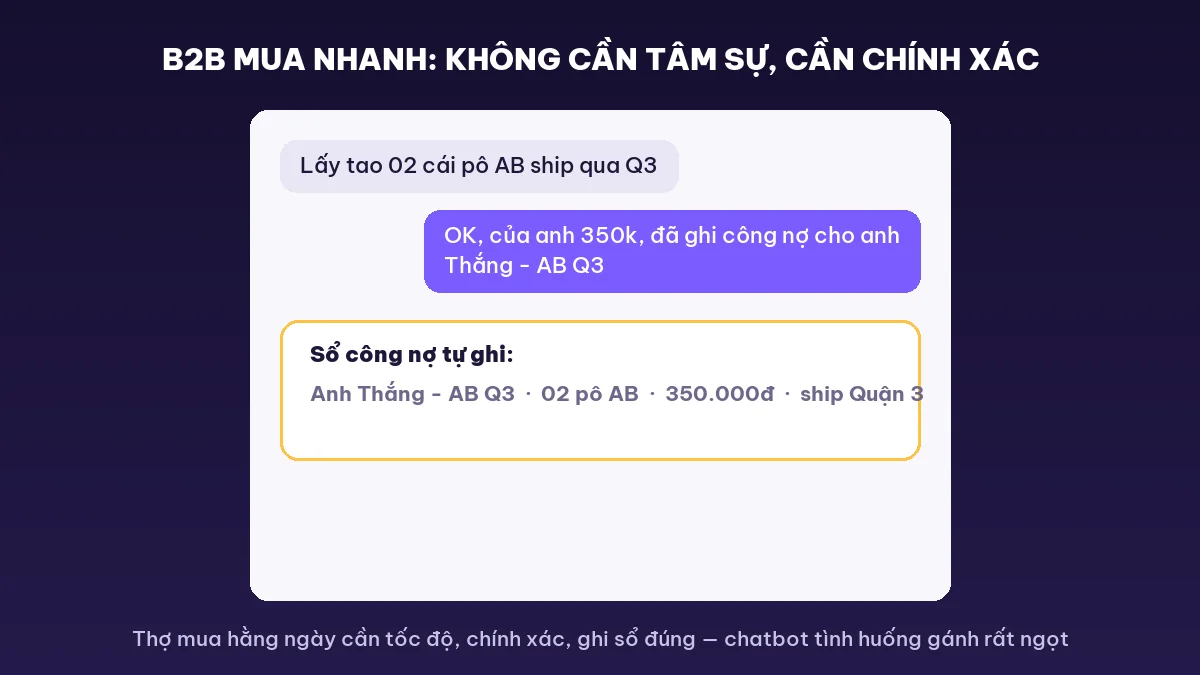
This is a problem we like to tell because it is so true to life. Picture a wholesale motorbike parts shop whose customers are mechanics buying every day like clockwork. At 7 am, a mechanic opens his shop and messages: send me 02 AB exhausts, ship to District 3. The bot replies within a second: OK, that's 350k for you, logged to the account of Mr. Thang, AB District 3.
The deal ends in two messages. The mechanic doesn't need the bot to say good morning, doesn't need advice on which exhaust suits his style, and definitely doesn't need anyone asking how he's been. Regular customers who buy every day need exactly 3 things: speed, accuracy and correct bookkeeping. For this problem, a neat decision tree does the job, and any extra word is a wasted word.
One fair word for the teams that have run this kind of chatbot for 20 years: they truly know their craft. They know which buttons customers tap, which branch they drop off at, and how to tune each line of text on a button to get more taps. That experience is a real asset of the industry, and it still makes money for many businesses today.
If you've read this far and still aren't sure which problem your shop falls into, call 1900 636 648 and tell us what you sell, how many people message per day and how many people are on page duty. MONA has built software since 2016 and delivered over 14,000 projects, so in about 5 minutes we can usually tell which type suits you, and that call doesn't commit you to buying anything. You can also visit MONA's chatbot demo page and try a few messages to see how the machine answers before deciding.
The second approach has only appeared in the last few years, with large language models, called LLMs in English, the technology behind ChatGPT. For readers who aren't technical: the machine is given a huge amount of human writing, so much that it picks up how people use language. As a result it understands natural writing instead of hunting for individual keywords as before. A chatbot built on this technology is the type MONA builds, and it differs from the scripted type right from how it receives a message.
The customer types: ao nay con sz M k sop. Abbreviated, misspelled, no diacritics. A scripted bot that finds none of its declared keywords asks the customer to choose again from the list of buttons, exactly as designed. An AI bot instantly reads that this is the question “does this shirt still come in size M?” and answers that directly. When a customer sends one message with 3 points, asking the price, asking the shipping fee and complaining that the last delivery was slow, the AI bot separates each point and answers them all. When the customer changes their mind midway, jumping from asking about a dress to asking about shoes, it keeps up with the thread.
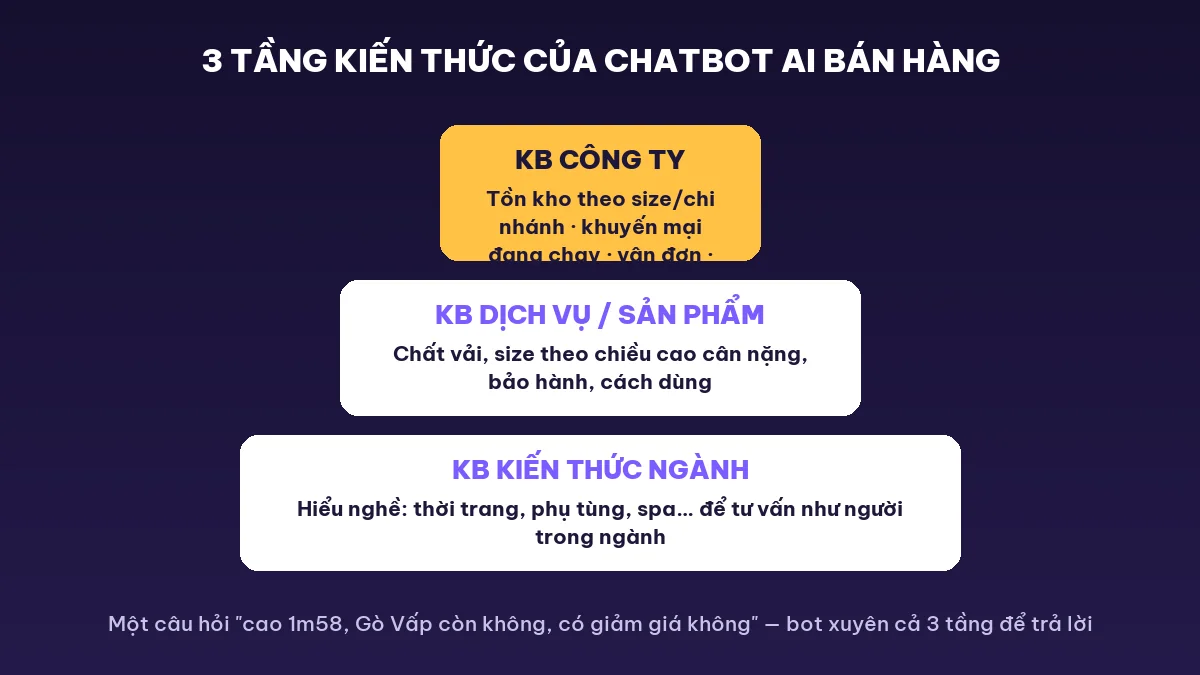
But please note one point, because this is where many people get it wrong: a large language model only knows general knowledge about the world, and it knows nothing about your shop. An AI bot that sells needs to be loaded with your own knowledge. The real strength of an AI sales chatbot lies in the 3 layers of knowledge loaded into it.
The first layer is industry knowledge. For a fashion shop, that means how cotton differs from linen, what size someone 1m60 and 55 kg should wear in this cut, and how to wash wool so it doesn't pill. This layer is easy to load: professional knowledge is hardly a market secret anymore. What's nice is that you can add your own signature to this layer, such as “this fabric is made only by my shop in Vietnam”, and the bot will advise in that voice.
The second layer is service and product knowledge. This layer is the shop's own data: each item's colors, price, size chart, whether it's a straight or fitted cut, and the return policy for each product line. Once this layer is loaded, the bot can advise like a well-prepared salesperson and compare one model with another instead of speaking in generalities.
The third layer is company data, the hard but valuable layer. This is the part that connects the bot to the business's management software: inventory by size and branch, promo codes for each campaign, shipping status, wholesale customers' account balances. Once connected, the bot can answer questions that staff would have to open several systems to look up. This layer also takes the most work to implement, but MONA is a B2B software company with over 10 years of experience and a team of 60+ staff, and linking data across many systems is something we do every day.
With all three layers together, a very real customer question can finally be answered in full. The customer messages: I'm 1m58 and 60 kg, what size of this dress should I get, does the Go Vap branch have it, and is it on sale? The industry layer handles the size advice, the product layer handles the cut of the dress, and the company layer checks Go Vap's stock and looks up the running promotion. The customer asks one question and gets one answer covering all 3 points. Before, that took a seasoned employee checking 3 places.
Who the AI type suits, based on our deployment experience: B2C retail, meaning selling to consumers, with products from a few hundred thousand to 1 or 2 million VND, sold mainly through chat. This customer group asks endlessly varied questions, each in their own way: someone asks about size, someone compares two models, someone wants same-day delivery, someone haggles, someone asks how to match outfits. No decision tree can write enough branches for all those kinds of questions. This is exactly where the understanding type thrives.
We did a calculation you can check yourself. One page-duty employee costs around 10 million VND a month once you count social insurance, leave, and the 13th-month bonus, and one person can serve at most about 100 customers a day before it gets stretched. A shop running ads with a few thousand messages a day would need 20 to 30 people to keep up. Multiply it out, and the salary alone for answering messages is a number that makes any shop owner pause when they hold the month-end payroll.
A chatbot with the same capacity costs about 1/10, sometimes 1/20, of that payroll. That figure doesn't yet count what a bot can do that people can't: being on duty at 2 am, never taking Tet off, and serving the thousandth customer of the day with the same care as the first. Run the numbers yourself once to be sure.
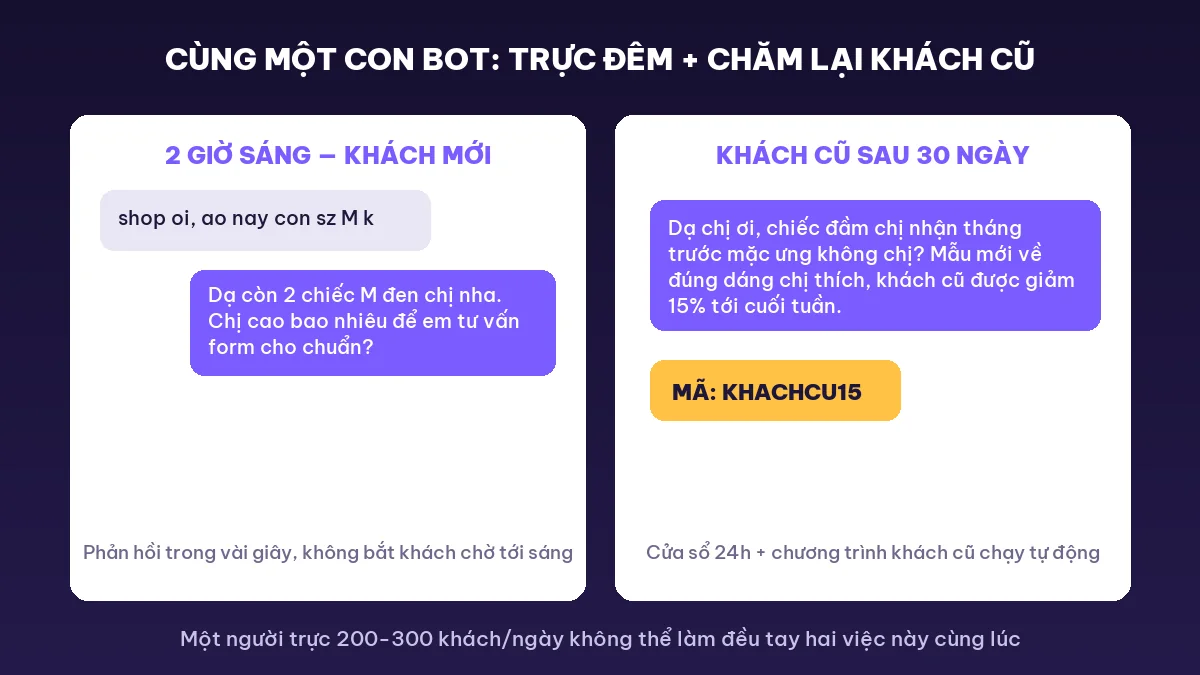
A modern auto-chat system for Zalo and Messenger doesn't stop at answering people who are asking. It also remembers each customer so it can come back to them. Within the 24-hour window that Messenger and Zalo allow for messaging back, the bot proactively checks in on someone who browsed yesterday but didn't buy, something like: you looked at that color yesterday, and we have these pants that are great too. If a customer looks too long without buying, the bot sends a personal offer, such as a 15% discount code for the exact item they were eyeing. After a purchase, a few days later it asks whether the product is working well, requests a photo and asks for a review.
One employee serving 200 or 300 customers a day can't remember who looked at what yesterday in order to follow up, and it's hard to blame them. A bot remembers each person, and that is where extra orders come from without spending another dong on ads. If you sell a lot on Zalo, you can also read the article Zalo order-closing chatbot we wrote specifically for this channel.
MONA's AI sales chatbot is called Dê Cười, and as of July 2026 it is running live for about 30 to 40 retail shops. To see how it advises on sizes, holds stock, places orders and tracks shipments, see the details on the page AI Agent chatbot that closes orders automatically.
Now to the part you've been waiting for: which type should you choose? Our honest answer is that no type wins overall, only the type that fits your problem better. MONA builds both types, so we have no reason to push you one way.
And if you go the scripted route and need to build the tree skillfully, we have an article ready sample sales chatbot scripts for you to see how to split the branches, so you don't have to start from scratch. Writing scripts is a craft too, and a skilled script and a clumsy one give very different results.
A scripted chatbot, also called a rule-based chatbot, runs on a decision tree that people write in advance: whichever button the customer taps or keyword they type, the bot replies with the exact line written for that branch. The machine never makes up its own words, so the business keeps full control of everything said in its name. This approach has run reliably for 20 years and still serves many large businesses well.
The difference is in how they understand a message. A scripted chatbot matches keywords and buttons against a library of prewritten replies, and when a message falls outside the script, it asks the customer to choose again. An AI chatbot is built on a large language model, so it understands natural writing, even abbreviations and typos, and answers using 3 layers of knowledge loaded into it: industry knowledge, product data and company data.
We suggest looking at how many people message each day. Under about 100 customers a day, one person on duty can still handle it, so there is no rush for you to invest in anything. When you run ads and the messages outgrow your team, or you lose a lot of late-night customers, that is when to consider a bot: if customer questions vary and need advice, choose the AI type; if customers mostly check orders and price lists, the scripted type is enough.
It depends on the bot type you use. If you want to close orders automatically on Facebook with a scripted bot, you need to write the script tree first, and the more carefully you write it, the fewer customers slip through. With an AI bot you no longer write every branch. Instead, you and the implementation team set up a persona for the bot, meaning the shop's tone and way of addressing customers, then load the 3 layers of knowledge so the bot can advise and place orders by itself.
A handy benchmark: for the same customer-handling capacity, a chatbot usually costs about 1/10 to 1/20 of the payroll of an equivalent page-support team. The exact figure depends on how deep the data connection goes; connecting to inventory, promotions and shipping takes more work. Call 1900 636 648 and tell us your shop's problem, and we will work out a figure close to reality before you decide.
We know that before reading this article, many of you had already tried every workaround: hiring extra people for the evening shift, tinkering with a free button bot yourself, spending a week writing sample replies, even stacking extra shifts on yourself so you hold your phone until midnight. Each one helped for a stretch, and that effort is real, we don't take it lightly. But however good a person is, they still need sleep, still go home for Tet, and still can't remember which of thousands of people looked at what yesterday. The problem of a shop with lots of customers isn't about hiring more people; it needs a system that is always on duty, remembers each customer and answers with the business's real data.
MONA has built software since 2016, with a team of 60+ staff, has delivered over 14,000 projects, and builds both chatbot types in this article. This week you can do 2 things right away: first, visit demo chatbot and try a few hard questions just like the ones your customers ask, to see how far the machine helps; second, call 1900 636 648 and tell us what your shop sells and how many people message per day. After listening, if the scripted type suits you, we will say so plainly and build the scripted type; if an AI sales chatbot suits you, we will build the one that fits your shop. Honest advice first, contract second.

CEO & Founder · The MONA
The founder of The MONA built a service company of 60+ staff with 14,000+ projects delivered. Khánh Hùng shares his thinking on building self-running systems, automating a business, and the real lessons behind MONA's projects.
 486




Professional website
design services
Own a website with a beautiful, 100% exclusive design and a lifetime warranty, with the ability
to expand features flexibly as your business grows, starting today!






 MONA will never sell your information or send you spam


 MONA will never sell your information or send you spam
