
 MONA OS 2.0
 Partner with MONA


 Tự động hoá doanh nghiệp
 Cẩm nang SEO
 Digital Marketing
 Kinh nghiệm thiết kế website
 Hạ Tầng Server
 Giáo dục


 VI
 EN










Message us on
Zalo Official


 ProductsNew

 ProductsProducts
 Mới ra mắtKHA AI 2027App tự edit video, tự đăng mọi mạng xã hội, 2 phút mỗi ngày










 Website designLooks good and wins customers over.
SEO servicesBrings in customers searching for exactly what you sell.
 Tư vấn digital marketingKéo khách từ nhiều kênh, đo bằng số thật.
Corporate video productionVideos introducing your company, factory and team.
 NewAI video productionCompany story films made with AI.
 Custom software developmentCRM, ERP and HRM built for your business.
 Viết AI Agent theo yêu cầuĐặt riêng một trợ lý AI cho đúng việc của mình.
 Tư vấn chuyển đổi AIĐưa AI vào vận hành của cả công ty.
NewMONA LMSManagement for centers and schools.
MONA SkillHubInternal training for company staff.
 NHTQ systemEnd-to-end China–Vietnam shipping operations.
MONA JMSManagement for gold, diamond and pawn shops.
 MONA E-LearningA website with every feature you need to sell courses.
 How to sell online courses (course)More than 30 free lessons on selling courses on autopilot.
 MONA Cloudmonacloud.vnServers to get your apps and websites running.
 MONA Basemonabase.vnPostgres database, sign-in and file storage.
 MONA Mailmonamail.vnSend OTP, order and invoice emails from your software.
 MONA Paymonapay.vnAccept bank transfers via VietQR and notify your software when the money arrives.
 MONA eInvoiceComing soonIssue e-invoices that meet tax standards.
Gấu CườiTrả lời khách 24/7 trên web, Fanpage, Zalo và thu lead cho sale.
 Gấu TeleSalesGọi điện tư vấn, chăm khách như tổng đài viên thật.
Dê CườiTư vấn và chốt đơn cho shop ngay trong khung chat.
Gấu WebmasterNhắn nhóm Zalo là website được sửa xong.
 Gấu Pháp ChếSoạn hợp đồng, rà điều khoản trong vài phút.
 Gấu Báo GiáLên báo giá đúng mẫu và gửi khách ngay.
 AI chăm sóc khách hàngTheo dõi và giữ chân khách hàng cũ.
 Gấu Tuyển DụngLọc hồ sơ, hẹn lịch, phỏng vấn ứng viên.
 Mới ra mắt
KHA AI 2027
Xây kênh chuyên gia 2 phút mỗi ngày
Quay bằng điện thoại, AI tự edit video, tự đăng lên 16 nền tảng và tự trả lời bình luận, tin nhắn.
419.469lượt xem trên kênh CEO MONA sau 23 ngày
 Anh Khánh HùngCEO MONA đang dùng mỗi ngày
Xem app làm được gì
 AI
Gấu Cười MONA ĐANG TỰ XÀITrả lời khách 24/7 trên website, Zalo OA, Messenger và thu lead về cho sale.
Dê CườiChốt đơn bán lẻ và sàn: Shopee, TikTok Shop, web. Chăm cả khách sỉ, đại lý.
Gấu WebmasterCập nhật nội dung, tối ưu SEO website mỗi ngày.
Gấu TeleSalesGọi điện tư vấn, chăm khách như tổng đài viên thật.
Gấu Tuyển DụngLọc hồ sơ, hẹn lịch, phỏng vấn ứng viên tự động.
AI chăm sóc khách hàngGiữ khách cũ, cứu lead đã rớt cho phòng kinh doanh.
Gấu Pháp ChếSoạn hợp đồng, rà điều khoản trong vài phút.
Gấu Báo GiáLên báo giá đúng mẫu, gửi khách ngay khi có yêu cầu.
 Chuyển đổi AI toàn phầnGiải pháp tổng cho doanh nghiệp, 3 lớp triển khai.
 Viết AI Agent theo yêu cầuĐặt riêng một con AI gánh đúng nghiệp vụ của bạn.
 Custom softwareCRM, ERP and HRM with built-in AI automation.
 SEO & AEO thời đại AIĐược Google lẫn AI trích dẫn, không chỉ xếp hạng.
 Kiến thức AI cho doanh nghiệpBài phân tích, hướng dẫn ứng dụng AI vào vận hành.
 Free AI courses
 AI tools at work
App mới · KHA AI 2027
Xây kênh 2 phút mỗi ngày
AI tự edit video, tự đăng mọi mạng xã hội
Free consultation, 8am–10pm every day

18 March, 2023

Want customers to “step into” your space from the very first look? 360° photography and VR tour services combined with high-quality drone footage from MONA Media turn every location into a vivid journey: smooth flights through the air, 360° turns to explore every detail, and images sharp down to the pixel. With one click, viewers can feel the architecture, scenery or product for themselves, which raises time on page and conversion rates. That lifts your brand and tells the story of your space in a memorable way. Read on for the details of 360-degree capture technology, 360-degree Virtual Tours and how to shoot sharp, standout 360-degree photos.
360-degree photography is an application of Virtual Reality (VR) technology. Images shot from several positions are stitched together around a fixed axis. To get a quality 360° photo, you need professional software or web tools. It is also called a virtual reality panorama: when viewing, you just use the 360 icon on the image and the picture rotates so you can see the whole surroundings.
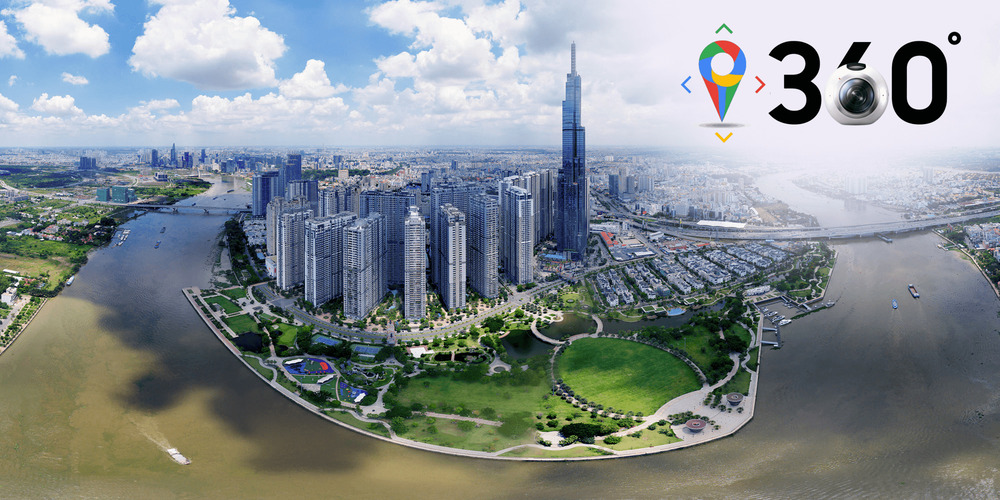
Technology A 360-degree Virtual Tour lets users take a virtual reality tour through linked 360-degree panorama photos. These images can be shot on site or come from a 3D SketchUp design. This technology is an important step in creating interactive virtual reality experiences for an audience.
A VRtour 360 service is the next step beyond 360-degree photos and 360 video. It gives viewers a wide view and lets them explore a space in the most intuitive and lively way. Viewers can choose where to go by clicking areas in the frame, which opens 360-degree images of smaller sub-spaces.
A drone 360 Virtual Tour also lets a business add a voice-over to introduce a project or guide viewers along a fixed route. This helps you reach customers effectively, share information and leave a strong impression, so they understand your product or project in detail.
A 360-degree photo is more than a wider frame. It is an immersive “window” that lets viewers look in every direction, while a traditional 2D photo records a scene from a single angle. Knowing the difference helps you choose the right storytelling tool: when you need an interactive experience, and when a light, easy-to-share still image is enough. See the table below for a comparison of 360° and regular photos.
| Element | 360-degree photo | Regular (2D) photo |
|---|---|---|
| Field of view | Covers a full 360° horizontally × 180° vertically, forming an image “sphere” so viewers can look in any direction | Limited by the lens focal length; for example a 50 mm lens on a full-frame camera covers only about 47° horizontally |
| Projection and aspect ratio | Usually stored as 2:1 equirectangular (e.g. 4096 × 2048 px) or 1:1 stereo; other projections (cubemap, EAC) are supported | Flat perspective projection; common aspect ratios are 3:2, 4:3, 16:9 and so on |
| Required metadata | Needs XMP GPano/Photo Sphere tags (ProjectionType, FullPanoWidthPixels, etc.) so platforms recognize the image as 360° | Only basic EXIF is needed (date, aperture, shutter speed and so on); it displays normally without XMP |
| Equipment and how it is shot | Needs a multi-lens 360 camera or a drone/flycam that stitches automatically; you can also shoot by hand and stitch with specialized software | Any camera or phone; each press of the shutter gives a finished frame |
| Display and interaction | Needs a 360 viewer (WebGL/VR “magic window”, VR headset); users drag the mouse, tilt the phone or wear a headset to look around | Viewed statically on any device; you can zoom in and out but cannot look around |
| Resolution and file size | To stay sharp when zoomed, 360° photos are usually 4K–16K wide (up to 16384 × 8192 px on Kuula), so files are larger | Phones typically shoot 12–20 MP (~4000 × 3000 px); files are smaller and load faster |
| Distortion and post-processing | Equirectangular images are heavily stretched at the poles (zenith/nadir); removing stitch lines and hiding the tripod needs specialized software | Only distortion from wide lenses; handled with ordinary Lightroom/Photoshop |
| Typical uses | Virtual tours for real estate, education and travel, live-streamed events, VR training | Product, portrait and landscape 2D photos, social media, print |
360-degree photography applies a brand-new Virtual Tour technology that businesses can use to create virtual reality experiences for customers. It is a powerful tool for promoting your business when you choose to shoot services or product photography in 360-degree format. Here are these reasons reasons to choose a 360 VRtour photography service for your business.

The 360 Tour approach gives you a completely new way to attract customers, with an interactive experience built on 360-degree panoramic photos. Instead of ordinary flat 2D images, 360VR photography lets customers interact with and explore every angle and direction of the place they want to see, without limits. This creates a hyper-real experience that gives customers a true feel for the product or location.
The tool can also be published across many platforms and devices, so users can experience it anytime, anywhere with an internet connection. It is also a strong helper for your communication and marketing campaigns . This innovation attracts customers through new technology and has been used effectively by many individuals and organizations.
As mentioned above, 360-degree photography has become a unique and fresh advertising channel for businesses that want a better customer experience. With 360 VR, customers can interact directly with a product or space in 360 degrees as if they had really walked into the store or location. Buyers get the chance to experience the product from every angle and explore every detailand specification, which helps them decide faster and trust your business more.
Many leading brands already use Virtual Tour 360 technology to create marketing campaign standout results. This technology is used across fields such as real estate, education, fashion, entertainment, events, restaurants, hotels and tourism. So why wait to use MONA Media's 360° VRtour photography service to help customers understand your business, products or services better?
Looking for TVC production or corporate video with vivid footage?
≫See also: TVC production, product and corporate advertising film production
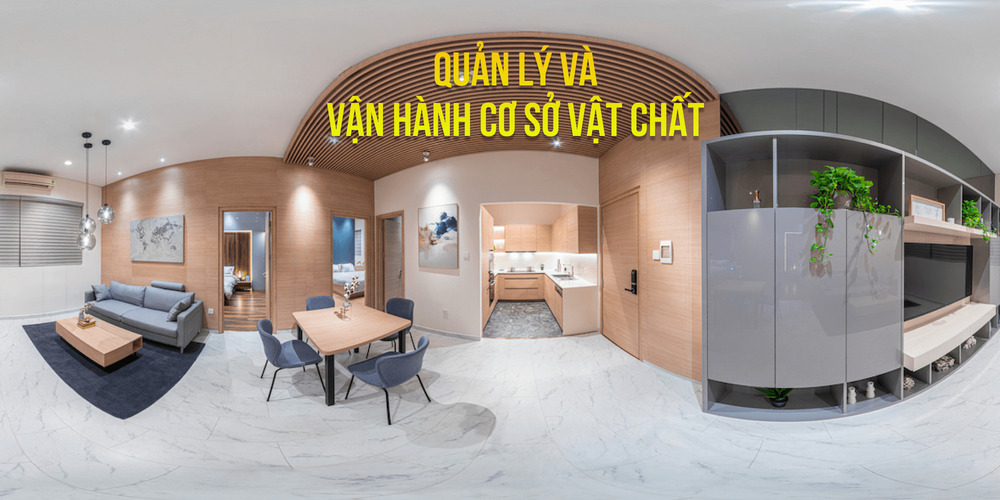
360° photography technology A Virtual Tour does more than attract potential customers; it is a way for businesses to monitor and run facilities effectively. It is especially useful for industries that need to track, monitor and manage information and data in detail. You can manage every detail, from product descriptions to floor plan information and spatial structure.
The system is also optimized to make it easy and convenient to control information and data. This can save time and resources in operating your facilities. The VRtour 360 service also helps keep the operation accurate and efficient.
This is the most common method of 360 panoramic photography because it is convenient and suits most market needs. A 3D scanner produces sharp images with very high accuracy. However, 3D scanners are prone to lighting interference, so they are mostly used indoors, where light is stable and can be controlled. Restaurants, hotels, cafés and other kinds of rooms benefit most from 360° images made by 3D scanning, thanks to the high resolution, speed and time savings.
For ground-level structures, shooting with a dedicated 360 camera is the best option. It is a low-cost method because the equipment and software are not very expensive. It does have 2 drawbacks: it takes a lot of time because the photographer has to measure by hand, and it is less accurate than 3D scanning. In return, a 360 Virtual Tour shot with a camera has no trouble with very large places or objects.
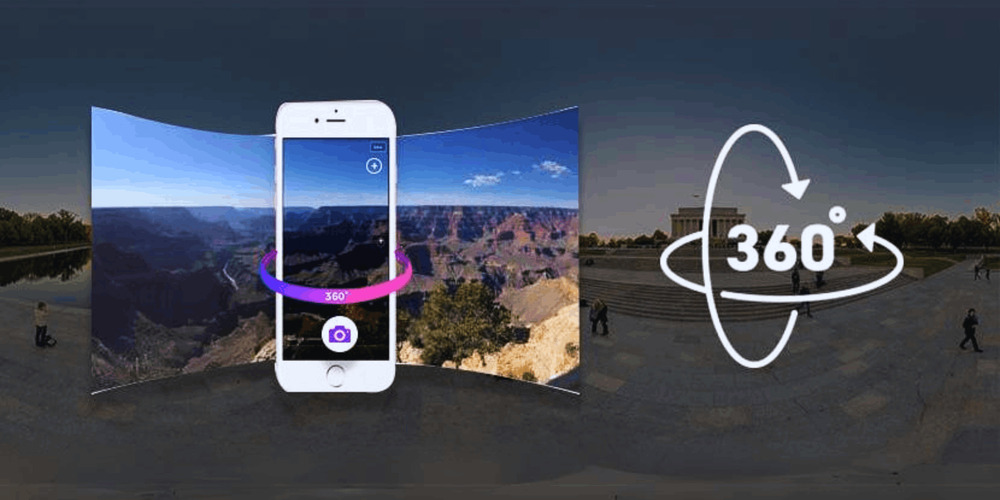
Because it suffers less from lighting interference than a 3D scanner, a Virtual Tour shot by hand with a 360 camera is the best fit for landscapes and outdoor architecture. It is not limited in view the way a 3D scanner is, so a 360° camera also suits large subjects such as cars, ships, offices and houses.
A drone (flycam) is a remote-controlled flying device used to film and photograph from above. It is also called a “flying camera” or an “unmanned aerial camera”. A drone can fly fast over a wide radius, and its impressive stabilization lets it work in windy conditions or at speed.
For jobs that need 360-degree photos, aerial footage or wide scenes such as: company introduction films, event filming, resort photography, real estate photography, tourist area, amusement park or urban area photography and so on, a drone virtual tour is the best choice.
When you use a drone for a 360 VR tour, you get perfect panoramic photos. Every detail is shown truthfully and clearly to the viewer. Because a drone shoots from a very wide angle, customers get a different experience from looking at ground-level photos.
|
MONA Media gives you drone filming services, 360-degree photography and professional VR tours. We offer a full-service package from photography to 360-degree filming, used for building 3D websitesand the most modern VR websites. Contact us now via HOTLINE 1900 636 648 for detailed advice. 
|
MONA Media brings you reliable, high-quality 360-degree photography, VRtour and drone photography. With a highly skilled team, our 360-degree photography service is carried out by MONA Studio and is running across the country on many large-scale projects. With dedication, MONA is committed to helping grow your business and build a professional brand image.

We offer a range of 360-degree capture options to suit your needs at different price levels. 360-degree images by the MONA team can be shot with a 3D scanner, with a dedicated camera using photogrammetry, or with a drone, as follows:
What do clients get from MONA Media's 360 photography and VRtour service?
To help you choose a VRtour 360 service for your business, MONA Media gives you the latest price list below:
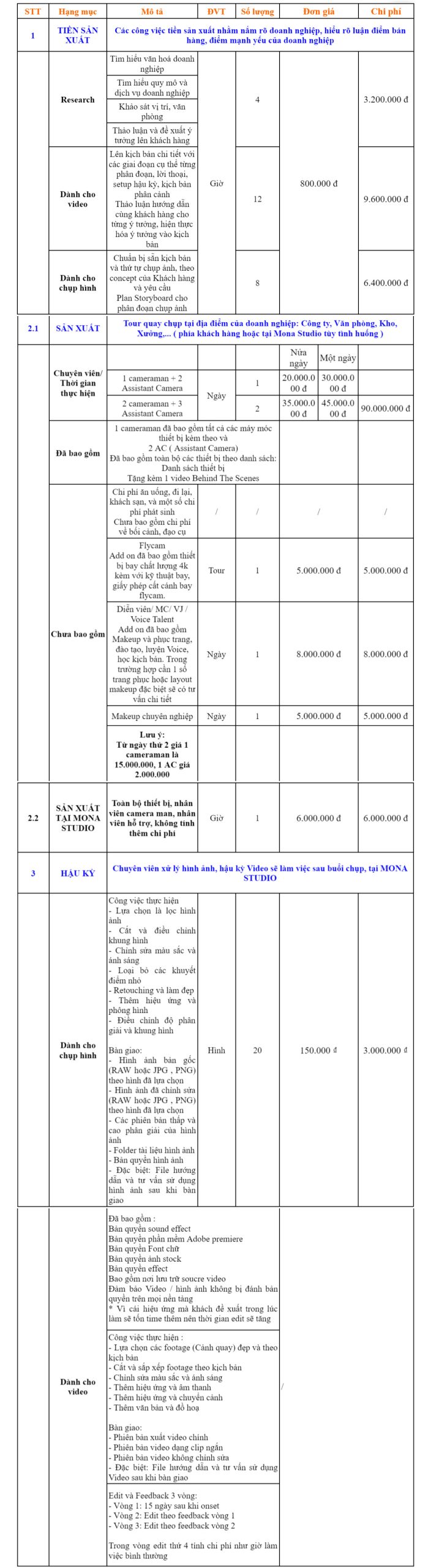
*Note, prices for the service may vary depending on many factors such as project scope, image resolution and your specific requirements.
For more details and a specific quote on VRtour and 360-degree photography services for your project. MONA also currently offers a range of plans such as shoot a corporate profile, personal portrait photography hay business portrait photography, and more, to meet every business communication need and help build a professional personal brand. Please HOTLINE 1900 636 648 or Email: info@themona.global contact us and the MONA team will advise and quote right away.
VRtour 360 technology is now used by many businesses to make their marketing more effective. With 360-degree photography you can create engaging interactive experiences that let customers explore a space, product or project in a vivid way. To help you understand the professional 360 VRtour process, MONA Media follows the complete process below:
►How do you create a VR360 Virtual Tour?
To create a VR360 Virtual Tour, you use 360-degree images, 360-degree video or 3D rendering to recreate a realistic environment. Users can navigate and interact in the Virtual Tour with a mouse on a computer, a keyboard, or the touch screen of a mobile device.
►Should you use a Virtual Tour 360 or Matterport 3D Scanning?
The choice between a VRtour 360 service and Matterport 3D Scanning depends on factors such as the space and the specific field of use. Matterport 3D Scanning is usually preferred for enclosed spaces of small to medium size, and the data is stored on the cloud of a third party, Matterport. A VR360 Virtual Tour, on the other hand, can be used in small or very large spaces, especially spaces with an overhead view such as a virtual site model.
If you work in tourism, real estate projects, industrial parks, schools and similar fields, a VR360 Virtual Tour can be a good choice thanks to its flexible features. You can customize the colors and design elements to make the product more eye-catching and better suited to your needs. If your project is an enclosed space such as a showroom or museum, you can use both technologies.
►How long does a 360-degree VRTour shoot take?
The time depends on the project's size and specific requirements; on average the process takes about 10 to 60 days. For the exact timeline of your project, please contact MONA Media qua HOTLINE 1900 636 648 for detailed advice.
In short, 360 Virtual Tour photography and 360-degree imagery are a trend of the new era and a way for individuals and businesses to grow and promote their image to everyone. Let our 360-degree Virtual Tour photography service at MONA Media be the partner that stays with you. Choose MONA Media and succeed in the digital age.
Contact us now if you need a professional, reliable team to communicate and spread your business message:

CEO & Founder · The MONA
Founder of The MONA, who built a services company of 200+ staff with 14,000+ projects delivered. Khánh Hùng shares how he thinks about building systems that run themselves, automating a business, and the real lessons from delivering projects at MONA.
 1,7K




Professional website
design services
Own a website with a beautiful, 100% exclusive design and a lifetime warranty, with the ability
to expand features flexibly as your business grows, starting today!






 MONA will never sell your information or send you spam


 MONA will never sell your information or send you spam
