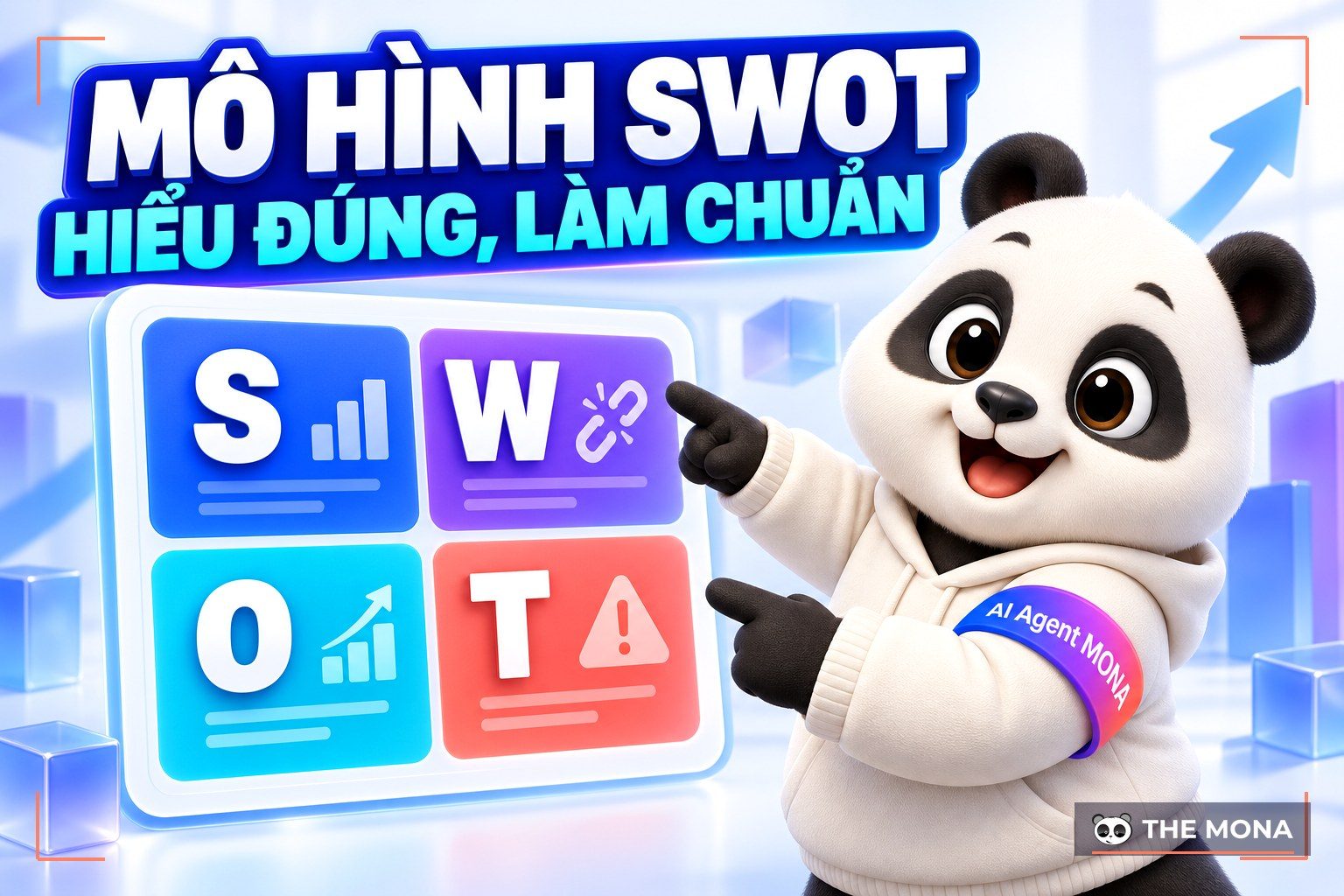
Quick summary: SWOT is a business analysis model named after Strengths, Weaknesses, Opportunities and Threats. Strengths and weaknesses are internal and can be changed. Opportunities and threats come from the outside, and the business does not control them directly. The model helps a business assess where it stands, set its growth strategy and steer clear of hidden risks in a systematic way.
The most important factor in whether a business succeeds or fails is knowing its own strengths and weaknesses. To do that, a business needs a sound method. That method is SWOT. So what is a SWOT matrix? How do you analyze and build one? The article below from Mona Media will help you understand it better.
Introduction to the SWOT model
What is the SWOT model?
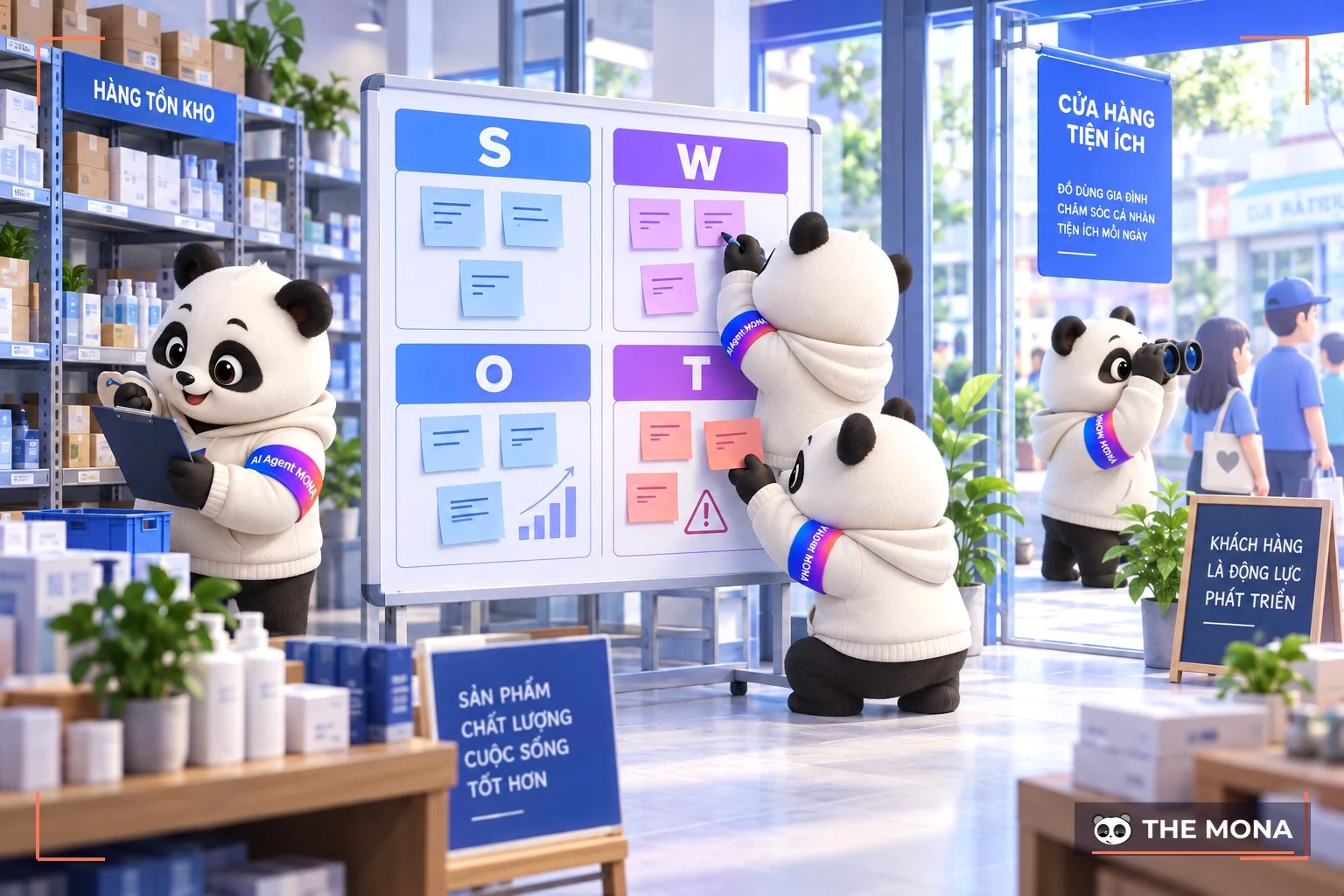
What is the SWOT model? SWOT is an acronym for four words: Strength, Weakness, Opportunities and Threats. It is a business analysis model that works as a starting point for building business strategy, and it applies to businesses of every kind. It helps a business re-orient its growth plan, build a solid foundation and change how it does business for the better. In this model, strengths and weaknesses come from the business itself, and both can change over time. Opportunities and threats are outside forces that the business cannot control.
->See more: What Is Pitching? What a Successful Pitch Needs, A to Z
What is SWOT model analysis?
When a business builds its production and business strategy, SWOT analysis is one of five key steps. The steps are: define the company's mission, run a SWOT analysis, set strategic goals, set specific objectives, and finally write the strategic plan together with the controls to monitor it. The main purpose of SWOT analysis is to help organizations understand the factors that affect their business decisions. The technique looks at the internal and external factors that can affect whether a decision will work, so organizations can decide more accurately. In short, SWOT analysis is a strategic planning technique with tools for identifying core strengths, weaknesses, opportunities and threats. It rests on facts, fresh viewpoints and new ideas. To get the most from it, run SWOT with input from teams or from people who have a real say in the organization, so you work from actual data and not from a formal announcement.
Origin of the SWOT model
The SWOT matrix was created by Albert Humphrey, an American management and business consultant, in the 1960s. While working at the Stanford Research Institute, he ran a survey of more than 500 of the top-earning companies ranked by Fortune magazine. The aim was to find out why so many companies failed to carry out their plans.
Over 9 years, more than 5,000 staff worked together to collect the views of 1,100 companies through 250 different evaluations. The first analysis model in the study was called SOFT, short for Satisfactory – Opportunity – Fault – Threat. In 1964 the research team decided to change the letter 'F' to 'W', and SOFT was officially renamed SWOT. -> See more: Digital Marketing explained: everything you need to know about the latest in Digital Marketing.
Benefits of the SWOT model
The SWOT analysis model is a useful tool for assessing where a business stands today, setting its competitive advantage and finding the challenges it has to solve. With SWOT, managers can assess the company's resources and competitive ability, and identify the opportunities and challenges that come from the outside. This gives managers an overview of the business now and in the future, so they can make suitable strategic plans and avoid hidden risks. That strengthens competitiveness and supports steady, long-term growth.
Pros and cons of SWOT
Advantages
It costs nothing: SWOT is one of the methods for analyzing how a business is performing. It is highly effective and saves a fair amount of money.
It gives you results that matter: SWOT shows a business its strengths, weaknesses, growth opportunities and the challenges it may face. Leaders can then draw lessons to improve the project and avoid unnecessary risks.
It brings new ideas: SWOT gives a business new ideas for operations and growth. It shows you your advantages as well as your gaps, so you can find solutions to problems now and in the future.
Disadvantages
The results are not in depth: SWOT analysis is only the first step of strategic analysis. It gives an overview of a business's internal and external factors without going deep into any one of them. The results are also not specific to a particular industry or a particular company. That means more research is needed to go deeper.
The results are subjective: A SWOT analysis can come out subjective when different managers or teams carry it out. The results can be shaped by each person's experience, viewpoint and knowledge.
More research is needed: SWOT only reflects the business's current situation and gives no specific recommendations or solutions. Extra research and deeper analysis are needed before a business makes the right strategic decisions.
->See more: Inbound Marketing explained: what you need to know about Inbound Marketing
What are the elements of SWOT?
Strengths
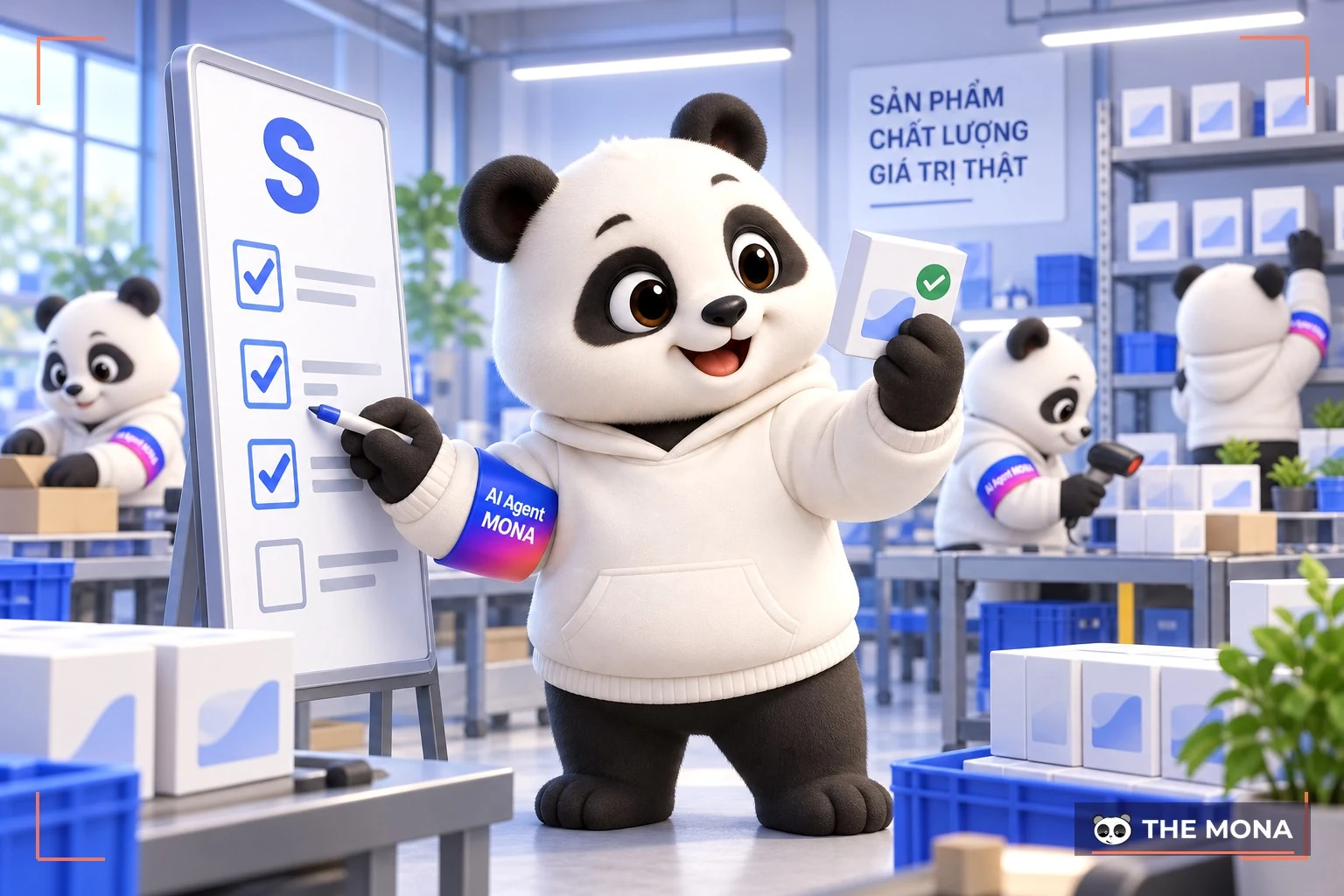
Strengths are the advantages that belong to your business, project or product and set it apart from competitors in the market. To find your strengths, ask yourself: What do you do best? What internal resources does your business own? What advantages do you have in people, knowledge, reputation, skills, relationships and technology? Here are some areas a business can use to identify its strengths:
To compete better in the market, a business needs to fix the main weaknesses it has. These can include:
Internal processes that need improving to raise efficiency and cut production costs.
Assets that need topping up, such as money and equipment, to compete better.
Gaps in the team that need filling, by hiring and training staff with the right expertise and skills.
The business location, which needs a second look to make sure it still suits later growth.
Opportunities
Outside factors that can help the business run more effectively and smoothly include:
A growing business market
Competitors that are slow, weak or have a bad reputation
Changing technology trends
Support from contracts, partners or investors
Seasonal and weather factors
Government policies and regulations
These factors can make your business easier to run and strengthen your competitiveness. -> See more: 7Ps in marketing explained: applying the 7P Marketing Mix in practice
Threats
A business faces many outside threats on the way to success. Here are some problems your organization may meet in the future:
Strong competition from potential rivals
Whether suppliers can deliver materials at a reasonable price
Negative effects of technology development
Customers who keep changing how they shop
The market may throw up challenges for the business in the future.
To deal with these threats, a business needs to make plans and build up its management skills to get through the challenges.
Turning the model into a SWOT matrix
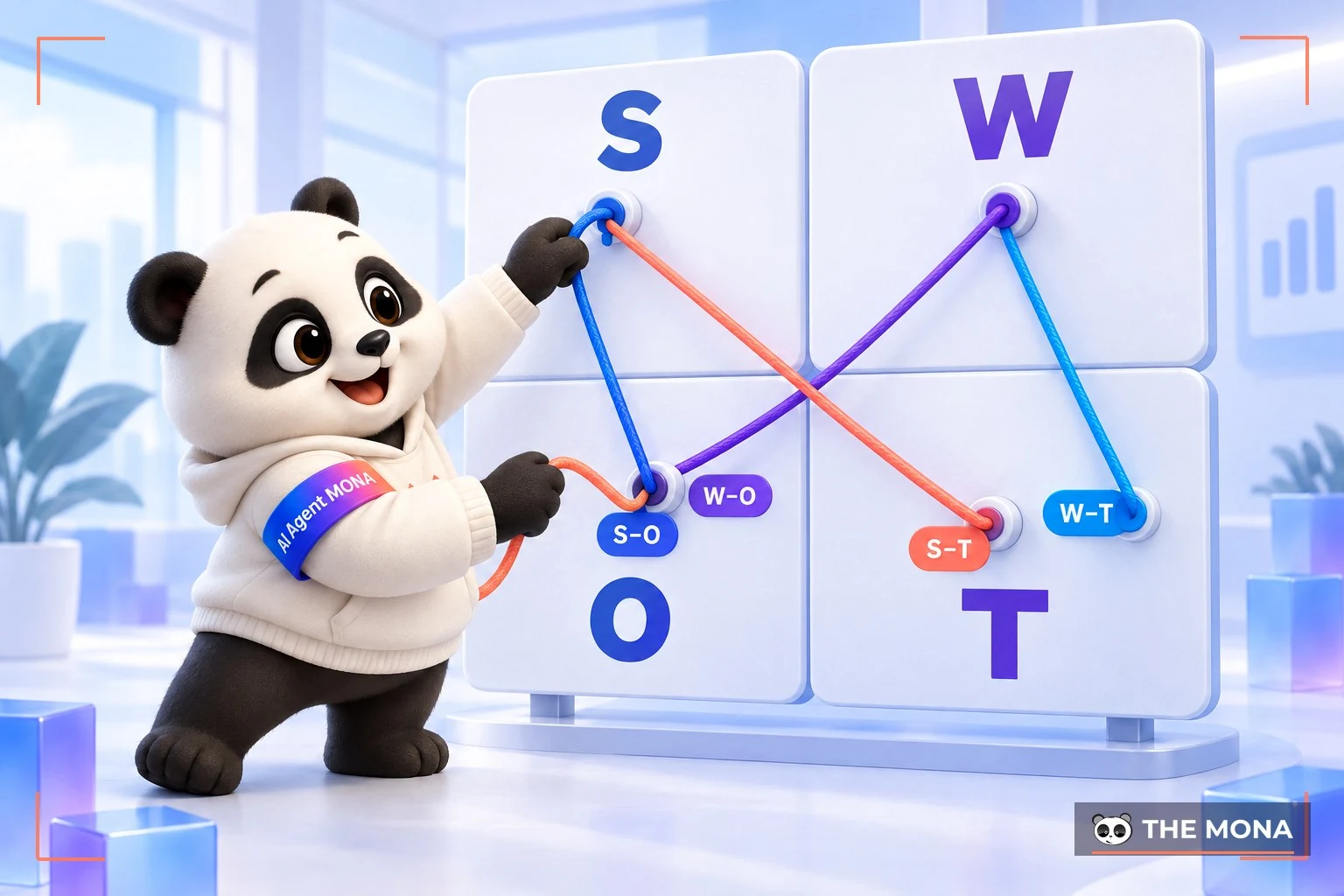
To get the full potential out of SWOT, we combine the elements into specific strategies. These strategies fall into 4 main types: S-O, W-O, S-T and W-T.
The S-O strategy uses outside opportunities to grow the organization's resources and strengths. It is highly effective and can be carried out in a short time.
The W-O strategy uses current opportunities by improving the organization's weaknesses and the things it has not yet done. It is a medium-term strategy and can bring positive results if carried out carefully and correctly.
The S-T strategy uses the organization's strengths to deal with and limit outside threats. It is a short-term strategy and can help a business remove risks and control an unfavorable situation.
Finally, the W-T strategy fixes the organization's weaknesses to avoid risk. Because risks often come from a business's own weaknesses, recognizing and fixing those weaknesses is extremely important. It is a defensive strategy and needs careful handling to work.
->See more: Marketing Funnel explained: how to build a marketing funnel for your business
Who is the SWOT model suitable for?
The SWOT model is one of the strategy techniques that individuals and businesses use most often to find their strengths, weaknesses, opportunities and market challenges. SWOT analysis can clarify your investment goals and show which factors affect those goals directly or indirectly. Some specific groups the SWOT model works well for:
Building on strengths and removing existing weaknesses
Solving many internal business issues, such as staffing, organizational structure of the leadership team and finances,
How to analyze and build a SWOT model, step by step
To see how each SWOT factor affects the business, the only way is to analyze them one by one. Think of your SWOT analysis as a coffee shop, with strengths, weaknesses, opportunities and threats as the items on the menu. Our SWOT analysis follows these steps:
Step 1: Set up the SWOT model
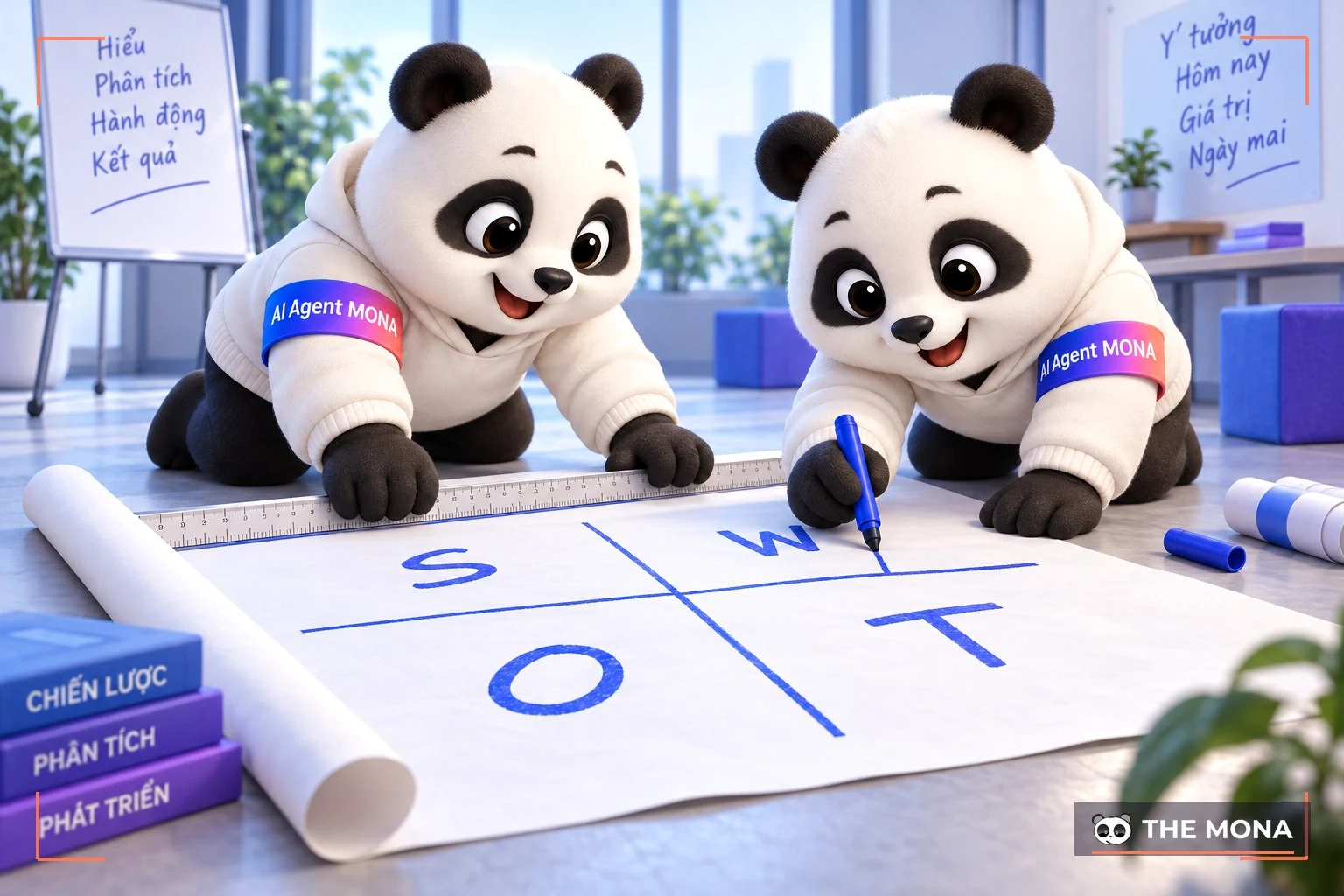
SWOT analysis is simpler if you lay the factors out as a matrix. A quick glance then shows the effects a business will meet throughout its growth and development. Once you have a solid matrix, build a business strategy from those factors. Note that the strategy must always cover 4 things:
Develop and use your strengths
Limit and fix your weaknesses
Take advantage of opportunities
Reduce risk.
Ideally, you should analyze strengths and weaknesses together, so you can turn weaknesses into strengths to grow on.
Step 2: Develop your strengths
Strengths you can find and use in a business include:
Business location is convenient
Facilities and equipment are modern and good quality
Company brand is well established and widely known
Products a wide range of product designs
Prices that are fair for the budget and the product quality.
Your business should also pair these strengths with the opportunities that are opening up:
Customer demand for your goods keeps rising
Production scale is growing and new products are being accepted
Strong growth potential through modern technology.
To make these pairings work, though, you need to work out which of your strengths fit each growth opportunity above. -> See more: Maslow's hierarchy of needs explained: how it is used in marketing
Step 3: Turn risk around
No business wants its strengths to go undeveloped when an opportunity comes, held back by threats instead. Every business wants to find and use its strengths, but reducing risk is the harder job. Risks cannot be predicted, and no one can guess everything that will happen in the future. That is why fixing internal risks is essential. It gives the business a solid foundation that does not shake when sudden risks appear later.
Step 4: Make use of opportunities
Business opportunities come from two main sources: the business creating them itself, or the market's reaction. Sometimes a business can create a new opportunity by analyzing market trends and acting on them early. Productivity and growth can then rise sharply. To catch these opportunities, every business needs to keep improving its products and services and keep researching the market to build an effective strategy.
Step 5: Remove the threats
In practice, you cannot remove all risk to a business. But anticipating risks can cut a lot of the damage caused by outside factors. Today, removing threats is a top growth goal for many businesses. So if you want to grow, face your business's threats head on. Each threat needs its own way of handling it.
The 4 biggest threats to every business are:
Competition is extremely intense
Large and small competitors differ widely
Customer trends and demand keep changing,
Cost so production is never steady.
How to use a SWOT table for yourself
Your personal SWOT analysis
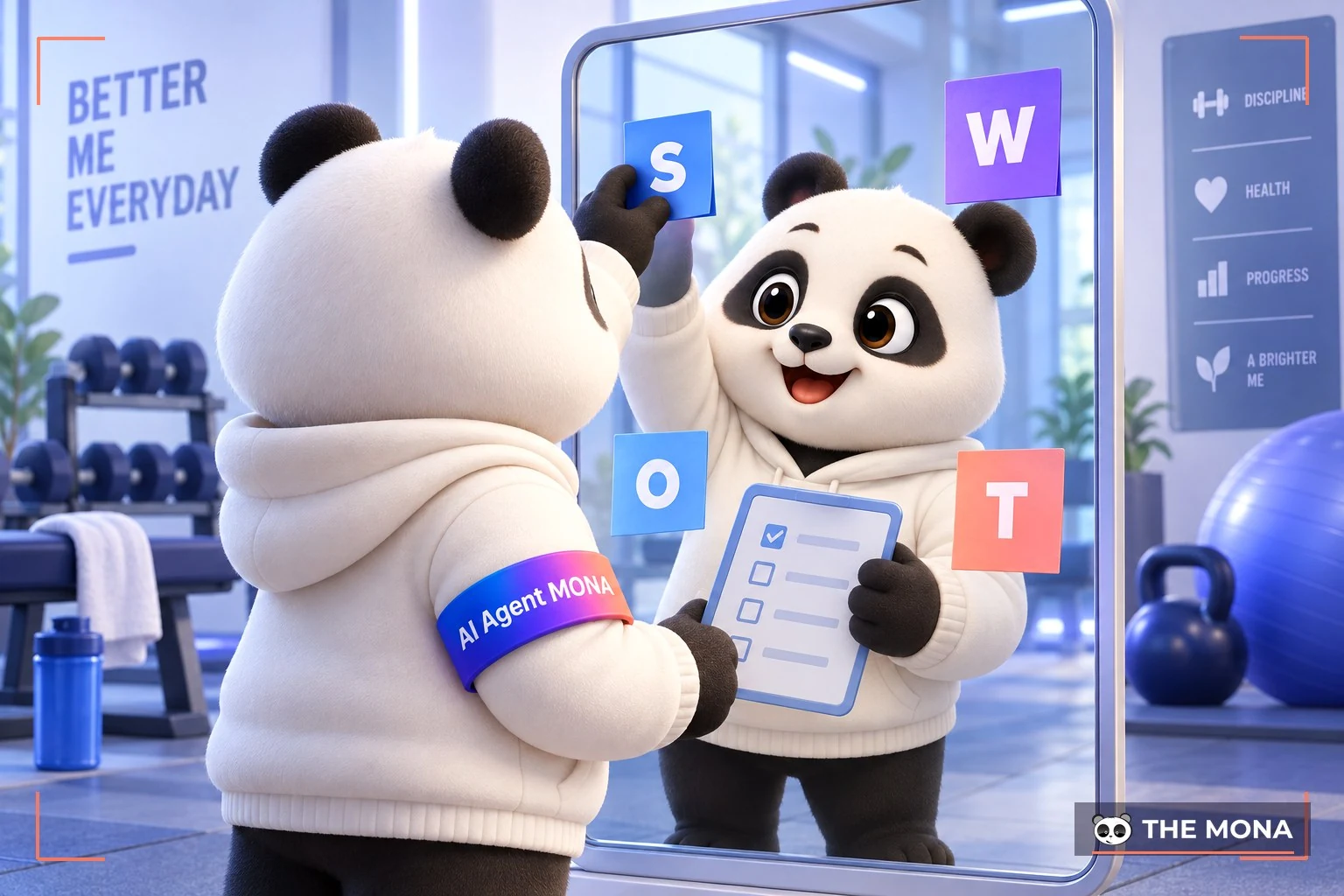
A personal SWOT table lists your own strengths, weaknesses, opportunities and threats. The analysis helps you understand yourself better, use your strengths, improve your weaknesses and catch opportunities. Use this model at each stage of your life to decide your next step in career and life.
How to make a SWOT analysis table
First, to run a personal SWOT analysis, list all your traits, including strengths and weaknesses, plus the opportunities and challenges you face right now. Once the list is complete, decide which of your qualities and abilities you are confident in and which set you apart from most people. Weaknesses, on the other hand, are the habits, skills or sides of yourself that need to improve or go.
Opportunities are the potential benefits from the outside world that you can use to your advantage. Threats are the factors that can get in the way of your goals and success. When the analysis is done, ask friends, family and a few colleagues you often work with for their view, so you get a more objective picture. -> See more: Growth Hacking explained: the secret to breakthrough growth with Growth Hacking
Questions to help you build your personal SWOT
To build a personal SWOT model, you also need to look at the 4 main factors S, W, O and T. To do that, ask yourself a series of questions about each one.
Strengths (S):
What skills or abilities do you have that others do not?
What do you do better than other people?
Which of your achievements are you proudest of?
Which of your values do you think are unusual and uncommon in others?
Do you have special relationships with any influential people?
How do others describe your personal resources?
What strengths do other people usually see in you?
What parts of your personality make others feel close to you and trust you?
Weaknesses (W):
Which skills do you need to improve to reach the same level as many other people?
Is there anything that makes you feel unsure of yourself around people?
Which habits stop you from doing your job as well as others?
Are you satisfied with your current level of knowledge and skills?
Which tasks do you tend to avoid because you lack confidence?
What do other people think your weaknesses are?
Which weak points in your personality hold you back?
Opportunities (O):
What can you use to get an advantage in your current environment?
What opportunities do you have to show your abilities and skills at work or in study?
Which new technologies can support you at work or in study?
Are salaries in your field going up?
Which courses could help you build your skills and grow in the future?
Is your dream job hiring now, or about to hire?
Is demand for people growing in your field?
Is there a chance to study or work abroad in your field?
Threats (T):
Has your job changed recently?
Are new technology advances affecting your work?
Could your weaknesses hurt your growth in your current job?
What difficulties are you facing at work?
Do you have competitors at work?
How competitive is your industry?
Is demand for people in your industry falling?
Is income in your industry below average?
Are there many competitors in the field you are pursuing?
SWOT analysis examples
SWOT analysis of Starbucks
If you still cannot picture how the SWOT model works, here is a concrete example. Starbucks has applied the SWOT model and arrived at the following analysis:
Strengths
One of the best-known coffee brands in the world
Ranked among the top 100 companies with ideal working conditions
A mission with real human value
Meets most customer needs
Weaknesses
Product innovation often fails
Has to invest in many countries to spread risk
Relies on coffee retail, so it does not stand out in other products
Opportunities
Very good at seizing opportunities
Once worked with Hewlett Packard to let customers burn their own music CDs
Can retail Starbucks products
Can expand its market
Huge influence from the brand
Threats:
Whether Starbucks' position will hold in the future
Rising prices of coffee and ingredients
Copyright theft
More competitors appearing with the same kind of products.
->See more: Fanpage explained: a step-by-step guide to creating a Facebook fanpage, A to Z
SWOT analysis of Apple
Strengths
Large market share: Apple is one of the companies with the biggest market share in consumer electronics, especially in smartphones and tablets.
Advanced technology: Apple is always first to adopt and develop new technology, from hardware to software, so its products consistently give users the best experience.
Wide product range: Apple makes more than smartphones and computers. It also sells smartwatches, headphones, smart speakers and many accessories.
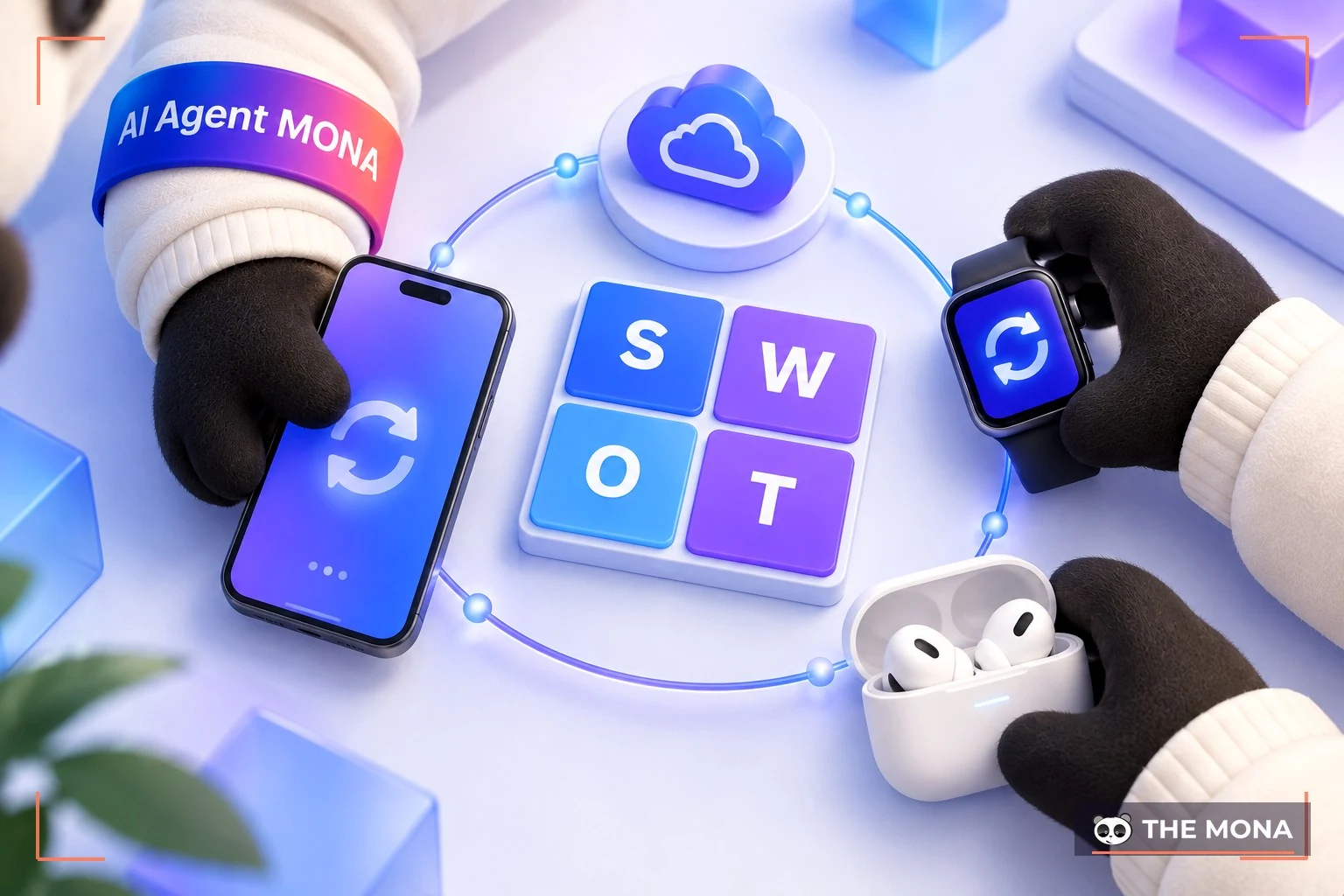
Stronger services: Apple offers cloud storage, music and video streaming, special apps and other services. Together they form a connected product ecosystem that serves customers better.
Design and quality: Apple products are always attractively and elegantly designed and built to a high standard, enough to satisfy the most demanding customers.
Customer loyalty: With good products, high quality and excellent service support, Apple has built a large base of loyal fans, which contributes to the company's lasting success.
Weaknesses
Limited advertising: Apple does not invest heavily in advertising to reach customers, which means some customers may not know about its latest products.
Limited design variety: Apple's designs tend to keep some features and styling from many years ago.
High prices: Apple products usually cost more than competing products, so many people cannot afford them.
Location tracking allegations: Some customers worry that Apple tracks their location and personal data, which lowers their trust in the company.
Only works with Apple software: Apple products usually work only with the company's own software and do not support third-party software.
Revenue depends on the iPhone: Apple's revenue relies mainly on iPhone sales, so if iPhone sales drop, its revenue drops too.
Opportunities
Developing AI technology lets Apple create smarter products and improve its services.
Building eco-friendly products can attract customers who care about the environment.
Using virtual reality (VR) and augmented reality (AR) can help Apple expand its product line and improve the user experience.
Apple can use people's reliance on technology to create new products and services that meet customer needs and increase sales.
Threats
Political tension: Apple faces trade and relationship issues with China, the US and other countries, which can affect the company's operations and plans.
The race for market share: The technology market is highly competitive, and rivals such as Samsung, Google and Amazon all have products that compete with Apple's, making it harder to hold its share.
Technology change: Technology is advancing fast, and adapting and developing new products to meet user needs is a major challenge for Apple.
Impact of the pandemic: The COVID-19 pandemic hit the global economy hard, lowering demand and revenue for Apple and possibly creating challenges in the future.
->See more: What Is Content? What You Need to Know and How to Build Content That Draws People In
SWOT analysis of Nike
Strengths
Nike is a strong competitor in the market.
Nike focuses on creativity and customer satisfaction.
Nike does not invest in its own factories, which frees the company from logistics challenges.
Nike uses a lean organizational structure to deliver maximum value to customers with minimum resources.
Nike understands customer trends well.
Weaknesses
Nike's weakness is that its sports product range is not very diverse. Most of its income comes from the premium market, which leaves the company exposed if that segment shrinks.
Nike's retail business is very sensitive to price. That is why Nike pays close attention to pricing when it sells, and runs its own retail stores under the Niketown name. Still, most of Nike's revenue and profit comes from selling to other retailers.
Opportunities
Nike can make use of the opportunity in product development. People buy Nike not only to play sport but also to show a fashionable style, which gives Nike room to develop new products with more fashion-led features and styling.
To increase revenue and profit, Nike can develop high-value accessories to go with its shoes, such as sunglasses and jewelry.
Nike can grow in international markets on the strength of its global brand recognition. High-income markets such as China and India tend to spend on expensive sportswear, especially among younger people.
Threats
Nike faces price and profit risk in international markets because buying and selling prices differ across currencies. These swings can lead to production or sales at a loss, a challenge common to international brands.
Clothing and footwear manufacturing is an extremely competitive market, and customers can choose from many suppliers at different prices.
Competitors are an important factor that Nike always has to watch.
This article, Mona Media has now covered everything about the SWOT model and how to apply SWOT in your business. It may feel unfamiliar when you first use it at work, but it will bring results far bigger than you expect.
FAQ
What does SWOT include?
SWOT has 4 elements: Strengths (internal advantages), Weaknesses (limitations to fix), Opportunities (outside factors that help the business) and Threats (risks and challenges from the outside that the business cannot control).
What is SWOT analysis used for?
SWOT analysis helps a business understand the factors behind its decisions, assess its competitive resources, spot opportunities and threats in its environment, and from there plan a suitable strategy and avoid hidden risks.
About The MONA Group: Founded in 2016, with more than 200 staff, MONA has delivered 14,000+ projects with an 85% client retention rate. MONA provides website design, full-scope SEO, custom software and AI automation solutions for businesses. Consulting hotline: 1900 636 648. Explore MONA AI Agent suite and MONA SEO services.
MONA has a podcast: listen instead of readingEpisodes on AI, automation & SEO for Vietnamese businesses
Founder of The MONA, who built a services company of 200+ staff with 14,000+ projects delivered. Khánh Hùng shares how he thinks about building systems that run themselves, automating a business, and the real lessons from delivering projects at MONA.
Own a website with a beautiful, 100% exclusive design and a lifetime warranty, with the ability
to expand features flexibly as your business grows, starting today!

 MONA OS 2.0
 Partner with MONA


 Tự động hoá doanh nghiệp
 Cẩm nang SEO
 Digital Marketing
 Kinh nghiệm thiết kế website
 Hạ Tầng Server
 Giáo dục


 VI
 EN











 ProductsNew

 Products
 Mới ra mắtKHA AI 2027App tự edit video, tự đăng mọi mạng xã hội, 2 phút mỗi ngày











 Tư vấn digital marketingKéo khách từ nhiều kênh, đo bằng số thật.
 NewAI video productionCompany story films made with AI.
 Custom software developmentCRM, ERP and HRM built for your business.
 Viết AI Agent theo yêu cầuĐặt riêng một trợ lý AI cho đúng việc của mình.
 Tư vấn chuyển đổi AIĐưa AI vào vận hành của cả công ty.
 NHTQ systemEnd-to-end China–Vietnam shipping operations.
 MONA E-LearningA website with every feature you need to sell courses.
 How to sell online courses (course)More than 30 free lessons on selling courses on autopilot.
 MONA Cloudmonacloud.vnServers to get your apps and websites running.
 MONA Basemonabase.vnPostgres database, sign-in and file storage.
 MONA Mailmonamail.vnSend OTP, order and invoice emails from your software.
 MONA Paymonapay.vnAccept bank transfers via VietQR and notify your software when the money arrives.
 MONA eInvoiceComing soonIssue e-invoices that meet tax standards.
 Gấu TeleSalesGọi điện tư vấn, chăm khách như tổng đài viên thật.
 Gấu Pháp ChếSoạn hợp đồng, rà điều khoản trong vài phút.
 Gấu Báo GiáLên báo giá đúng mẫu và gửi khách ngay.
 AI chăm sóc khách hàngTheo dõi và giữ chân khách hàng cũ.
 Gấu Tuyển DụngLọc hồ sơ, hẹn lịch, phỏng vấn ứng viên.
 Mới ra mắt
KHA AI 2027
Xây kênh chuyên gia 2 phút mỗi ngày
Quay bằng điện thoại, AI tự edit video, tự đăng lên 16 nền tảng và tự trả lời bình luận, tin nhắn.
562.273lượt xem trên kênh CEO MONA sau 25 ngày
 Anh Khánh HùngCEO MONA đang dùng mỗi ngày
Xem app làm được gì
 AI
 Chuyển đổi AI toàn phầnGiải pháp tổng cho doanh nghiệp, 3 lớp triển khai.
 Viết AI Agent theo yêu cầuĐặt riêng một con AI gánh đúng nghiệp vụ của bạn.
 Custom softwareCRM, ERP and HRM with built-in AI automation.
 SEO & AEO thời đại AIĐược Google lẫn AI trích dẫn, không chỉ xếp hạng.
 Kiến thức AI cho doanh nghiệpBài phân tích, hướng dẫn ứng dụng AI vào vận hành.
 Free AI courses
 AI tools at work

 ->See more: What Is Pitching? What a Successful Pitch Needs, A to Z
 Over 9 years, more than 5,000 staff worked together to collect the views of 1,100 companies through 250 different evaluations. The first analysis model in the study was called SOFT, short for Satisfactory – Opportunity – Fault – Threat. In 1964 the research team decided to change the letter 'F' to 'W', and SOFT was officially renamed SWOT. -> See more: Digital Marketing explained: everything you need to know about the latest in Digital Marketing.


 ->See more: Marketing Funnel explained: how to build a marketing funnel for your business
 SWOT analysis is simpler if you lay the factors out as a matrix. A quick glance then shows the effects a business will meet throughout its growth and development. Once you have a solid matrix, build a business strategy from those factors. Note that the strategy must always cover 4 things:
 Business opportunities come from two main sources: the business creating them itself, or the market's reaction. Sometimes a business can create a new opportunity by analyzing market trends and acting on them early. Productivity and growth can then rise sharply. To catch these opportunities, every business needs to keep improving its products and services and keep researching the market to build an effective strategy.
 Opportunities are the potential benefits from the outside world that you can use to your advantage. Threats are the factors that can get in the way of your goals and success. When the analysis is done, ask friends, family and a few colleagues you often work with for their view, so you get a more objective picture. -> See more: Growth Hacking explained: the secret to breakthrough growth with Growth Hacking



 1,5K









 MONA will never sell your information or send you spam


