
 MONA OS 2.0
 Partner with MONA


 Tự động hoá doanh nghiệp
 Cẩm nang SEO
 Digital Marketing
 Kinh nghiệm thiết kế website
 Hạ Tầng Server
 Giáo dục


 VI
 EN

















Message us on
Zalo Official


 ProductsNew

 ProductsProducts
 Mới ra mắtKHA AI 2027App tự edit video, tự đăng mọi mạng xã hội, 2 phút mỗi ngày










 Website designLooks good and wins customers over.
SEO servicesBrings in customers searching for exactly what you sell.
 Tư vấn digital marketingKéo khách từ nhiều kênh, đo bằng số thật.
Corporate video productionVideos introducing your company, factory and team.
 NewAI video productionCompany story films made with AI.
 Custom software developmentCRM, ERP and HRM built for your business.
 Viết AI Agent theo yêu cầuĐặt riêng một trợ lý AI cho đúng việc của mình.
 Tư vấn chuyển đổi AIĐưa AI vào vận hành của cả công ty.
NewMONA LMSManagement for centers and schools.
MONA SkillHubInternal training for company staff.
 NHTQ systemEnd-to-end China–Vietnam shipping operations.
MONA JMSManagement for gold, diamond and pawn shops.
 MONA E-LearningA website with every feature you need to sell courses.
 How to sell online courses (course)More than 30 free lessons on selling courses on autopilot.
 MONA Cloudmonacloud.vnServers to get your apps and websites running.
 MONA Basemonabase.vnPostgres database, sign-in and file storage.
 MONA Mailmonamail.vnSend OTP, order and invoice emails from your software.
 MONA Paymonapay.vnAccept bank transfers via VietQR and notify your software when the money arrives.
 MONA eInvoiceComing soonIssue e-invoices that meet tax standards.
Gấu CườiTrả lời khách 24/7 trên web, Fanpage, Zalo và thu lead cho sale.
 Gấu TeleSalesGọi điện tư vấn, chăm khách như tổng đài viên thật.
Dê CườiTư vấn và chốt đơn cho shop ngay trong khung chat.
Gấu WebmasterNhắn nhóm Zalo là website được sửa xong.
 Gấu Pháp ChếSoạn hợp đồng, rà điều khoản trong vài phút.
 Gấu Báo GiáLên báo giá đúng mẫu và gửi khách ngay.
 AI chăm sóc khách hàngTheo dõi và giữ chân khách hàng cũ.
 Gấu Tuyển DụngLọc hồ sơ, hẹn lịch, phỏng vấn ứng viên.
 Mới ra mắt
KHA AI 2027
Xây kênh chuyên gia 2 phút mỗi ngày
Quay bằng điện thoại, AI tự edit video, tự đăng lên 16 nền tảng và tự trả lời bình luận, tin nhắn.
960.023lượt xem trên kênh CEO MONA sau 54 ngày
 Anh Khánh HùngCEO MONA đang dùng mỗi ngày
Xem app làm được gì
 AI
Gấu Cười MONA ĐANG TỰ XÀITrả lời khách 24/7 trên website, Zalo OA, Messenger và thu lead về cho sale.
Dê CườiChốt đơn bán lẻ và sàn: Shopee, TikTok Shop, web. Chăm cả khách sỉ, đại lý.
Gấu WebmasterCập nhật nội dung, tối ưu SEO website mỗi ngày.
Gấu TeleSalesGọi điện tư vấn, chăm khách như tổng đài viên thật.
Gấu Tuyển DụngLọc hồ sơ, hẹn lịch, phỏng vấn ứng viên tự động.
AI chăm sóc khách hàngGiữ khách cũ, cứu lead đã rớt cho phòng kinh doanh.
Gấu Pháp ChếSoạn hợp đồng, rà điều khoản trong vài phút.
Gấu Báo GiáLên báo giá đúng mẫu, gửi khách ngay khi có yêu cầu.
 Chuyển đổi AI toàn phầnGiải pháp tổng cho doanh nghiệp, 3 lớp triển khai.
 Viết AI Agent theo yêu cầuĐặt riêng một con AI gánh đúng nghiệp vụ của bạn.
 Custom softwareCRM, ERP and HRM with built-in AI automation.
 SEO & AEO thời đại AIĐược Google lẫn AI trích dẫn, không chỉ xếp hạng.
 Kiến thức AI cho doanh nghiệpBài phân tích, hướng dẫn ứng dụng AI vào vận hành.
 Free AI courses
 AI tools at work
App mới · KHA AI 2027
Xây kênh 2 phút mỗi ngày
AI tự edit video, tự đăng mọi mạng xã hội
Free consultation, 8am–10pm every day

06 September, 2026

You've just typed a great-sounding SEO title, published it, and assumed the optimization was done. The next morning, page one shows a stub of text cut off mid-sentence, losing your most important message. Worse, some tag buried deep in the body gets pulled up to stand in for the Google-rewritten title you worked so hard on. Customers come to MONA complaining about this all the time, because the page isn't bringing in a single order.
This really is a familiar story.
After many SEO projects, we've realized the line between a page that draws customers and a page that gets ignored is sometimes just 50 px on a phone screen. Spend 30 minutes reviewing your description tags and you can rescue dozens of clicks a day through modern SEO tools ones. Please don't leave your site's fate to an automatic trimming algorithm. In this post we'll expose why the machine reworks your content and show how to lock down the displayed wording with exact measurements.
The figures we rely on are specific: a Zyppy study recorded 61.6% of titles being rewritten by Google, and a title on desktop can only show about 600 px of width. Picture a content staffer chewing a pen for 2 days to produce a title that fits, cramming in three keywords in hopes of ranking. The next morning they open Checking your website's rank on Google, and the platform ignores that line entirely and uses a single promo banner line from the top of the site as the displayed title. It feels like tailoring an expensive suit for a party and the doorman making you wear a raincoat to get in.
That feeling is infuriating.
We've had to explain until we were blue in the face to clients why doing SEO services pushed them up to position 3 while click-through rate collapsed, costing them 10 orders. Clients insisted the MONA team forgot to enter the meta tag or that the system had a technical bug. In reality, the search engine analyzed it and decided the wording you polished didn't reflect what users actually wanted to read at that moment.
We always tell the team to stop fixing blindly, because forcing a model to read empty phrases only wastes hours. Diagnose first, then prescribe. Don't rush to blame the machine; check whether your source content is tricking the filter with stuffed keywords. This hurts your chance to sell.

Seeing click reports fall while rankings hold steady, you'll be confused unless you understand the rules behind this heavy-handed intervention. It's no accident that the system bothers to distort other people's content. A major update in August 2021 completely changed how titles display, forcing site admins to rethink their whole strategy. The system applies this rule to protect users.
Avoid getting it wrong from the start.
Zyppy's 2022 study points to a startling number: 61.6% of title tags were rewritten, entirely or in part, across 2,370 different websites. We compared the data from our own campaigns and distilled 6 common mistakes that all but guarantee a title gets shredded. First, writing too long, so the screen can't fit it on one line. The second and most common is stuffing keywords too far.
Third is copying the same text across 10 child pages instead of using canonical tag sensible ones. Fourth is leaving the tag empty altogether. Fifth is forgetting to stamp the brand name at the end of the text. Sixth is using odd symbols for visual emphasis, which confuses the search engine's complex language parser. Typing without measuring means you're handing clicks to your competitors. Stop writing long, unfocused titles right now.
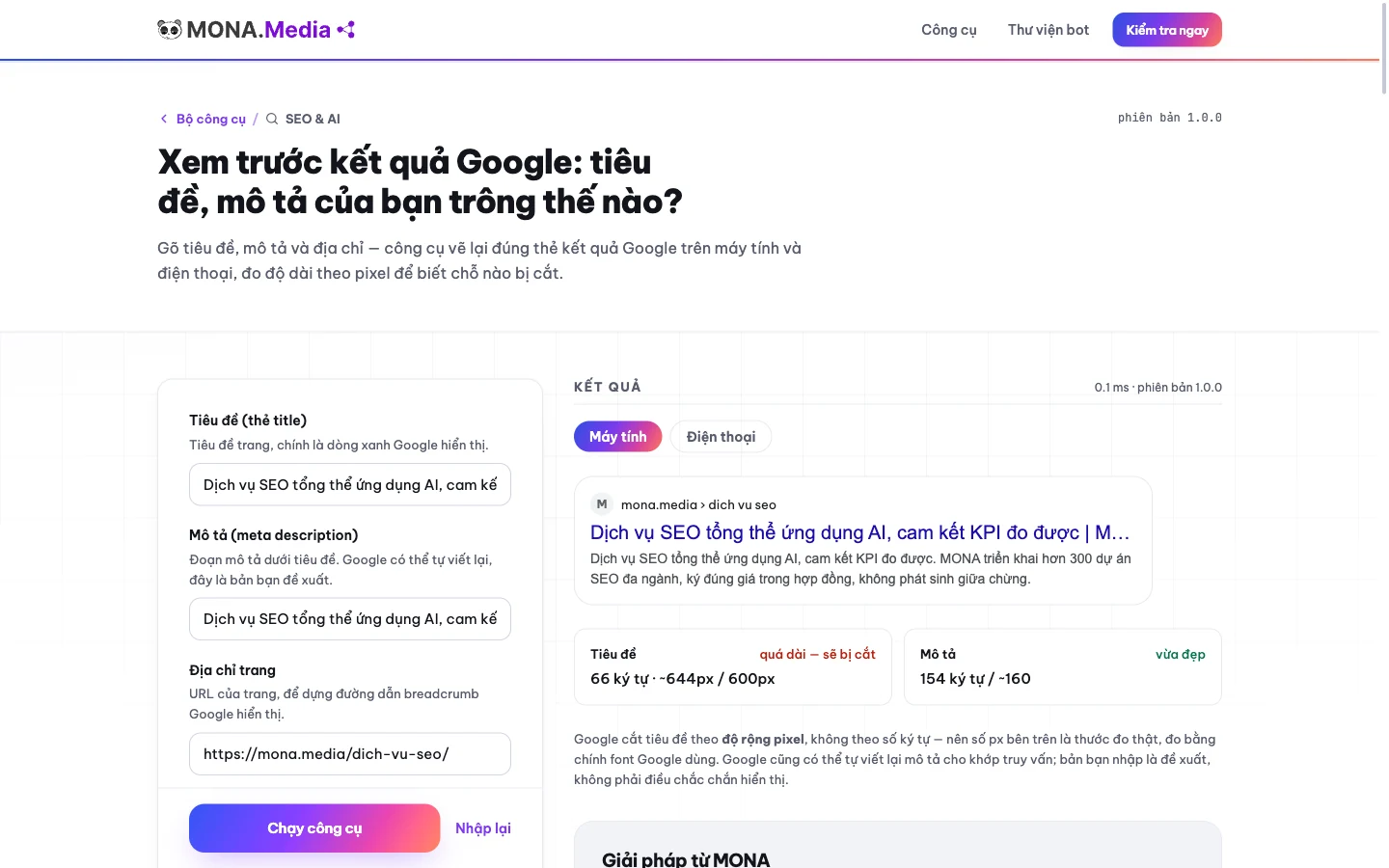
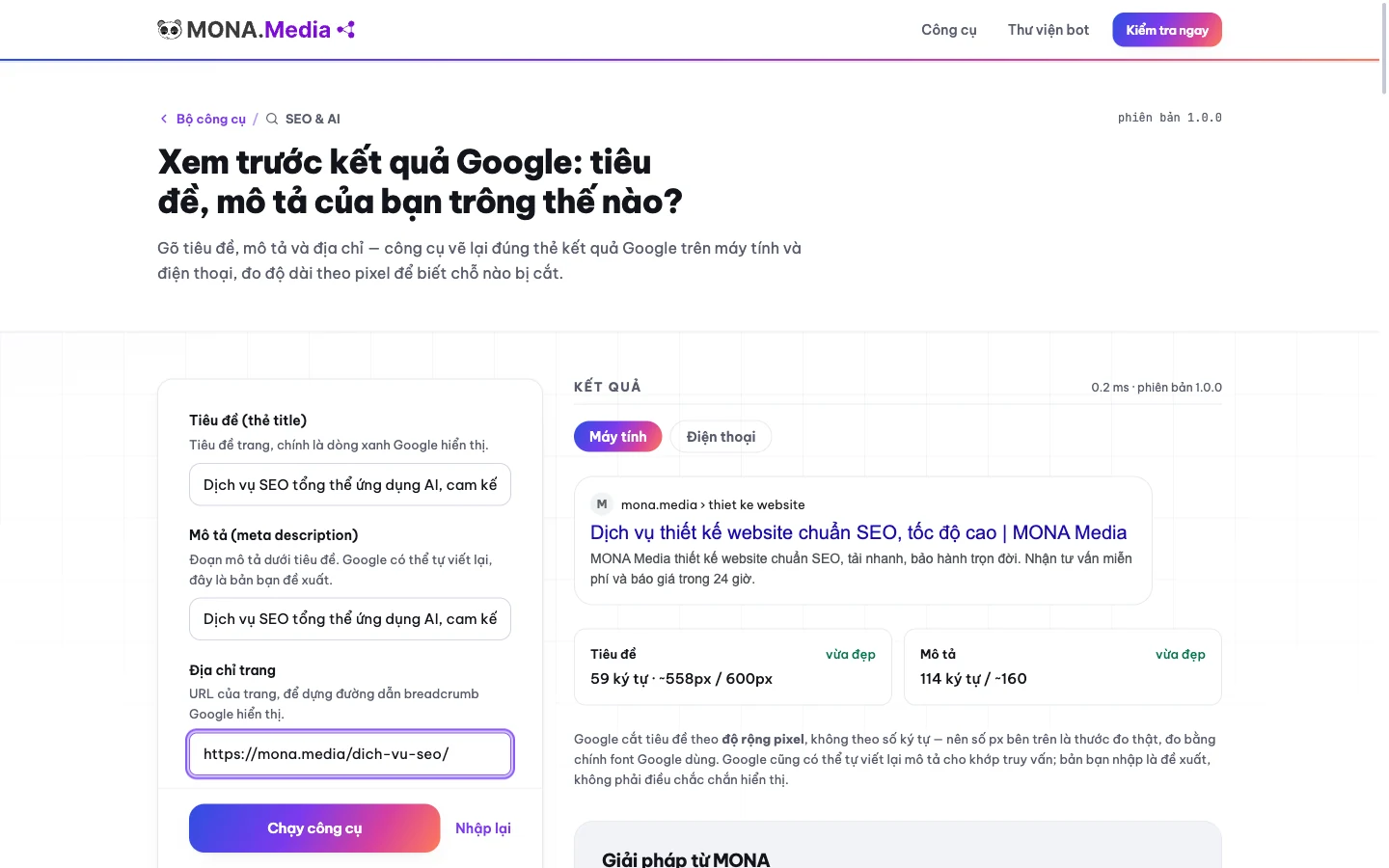
Typing in Word and counting exactly 60 characters, then patting yourself on the back, is how someone who has never opened a phone to see the real results works. A letter like “m” or “w” is wide and hefty, while “i” or “l” is skinny and takes only 10 px on screen. Add it up, and a sixty-character line full of fat letters spills past the limit, forcing the server to end it with an ellipsis. The habit of counting characters is a spectacular trap.
Measuring by eye costs you money.
Go straight to the Google results preview tool we built, paste your text in and hit check right away. At noon on September 6, 2026, we pasted a long passage into the box, and the 3 most important sales words instantly vanished from the phone screen. The tool measures strictly point by point on the display, redrawing exactly the frame you'll see on every kind of mobile device today. Our customers website design in Ho Chi Minh City don't need to create an account or pay; just paste your text and you'll see right away how the 600 px limit gets broken.
When you spot a wrong display, trim it right away. Keep trimming until the blue bar sits within the safe line, and never compromise on a single extra word.
You pay a content team to write each post and optimize each tag, hoping for a miracle. The department head reports a post made the top, then the boss opens it and sees the title chopped short, even losing the key phone number. All that careful work (editing again and again, weighing every word, arguing over every comma) is pointless when the machine decides to rework it its own way. Stop this blind money-burning now. Paste your title into our tool and measure it pixel by pixel. Measure pixels for free right here.

Hand your writers a task and just say “write it well,” and you get back 10 identical, bland pages with the wrong display format. We've been through countless failed tests and run into every awkward kind of algorithm while operating real systems. From those cases, MONA distilled 5 rules so Google keeps the line you want shown.
Ignoring the rules means failing.
Apply these 5 rules and you're through. The first rule: the main message must match exactly what the page sells, no bait and switch. Second, pack the core idea into the first half of the line, making sure the first 30 px hold the key keyword. Third, the heading tag inside the page and the outer title tag must not contradict each other.
This point plays a very important role. Fourth, the brand name goes last, separated by a single dash. Customers who see it often develop trust on their own. Finally, say no to hollow words like “leading,” “professional,” and “best in the world.” We enforce the SEO title standard on every campaign, with no page exempt.
The short passage right under the title works like a sales pitch that decides whether a customer walks into the shop. According to our Ahrefs figures, the keyword “meta description generator” gets 150 searches a month, and “what is a meta description tag” about 80. Many lazy business owners hand this job entirely over to AI software. The result is meta description bland, generic text so vague it would fit 5 different pages, yet persuades nobody to open their wallet.
Write with real thinking.
Computers churn out words fast, but they don't feel the customer's pain. When an auto-generated description doesn't match search intent, the system discards it and grabs a random 30-word passage from the body to patch in. Then you'll see a few error messages or a category menu snippet that brings in not a single order. Content generators are good at suggesting a starting idea, but the line that closes the sale must be edited by careful human hands.
Please don't overuse automation.
Theory alone has everyone nodding, but applying it in practice leaves people fumbling and taking 3 days to fix one tag. To show the huge impact of a few dozen cut pixels, we tracked the change across 3 core page groups: service pages, product pages and shared articles website knowledge. At the same ranking, the number of clicks swung dramatically once the display boundary was handled properly.
These are the real numbers.
| Page type | Initial state | After MONA's pixel tuning | Result |
|---|---|---|---|
| The services module on a real estate website lets the business present clearly what it offers, which builds trust and professionalism with customers. | Reputable professional industrial cleaning service at the cheapest price in… (cut off) | Cheap industrial cleaning service – Survey in 30 min – Brand name | Clicks rose sharply, and customers saw the strengths right away |
| Product page | Kangaroo KG110 RO water purifier, 9 filter stages, tempered glass cabinet… (cut off) | Kangaroo KG110 RO water purifier, 9 stages – Free installation – Brand name | Customers aren't overwhelmed and see the offer clearly |
| Shared articles | Top 10 ways to make salted egg cheese melting sponge cake at home… (cut off) | 10 ways to make salted egg cheese sponge cake at home – Brand name | A tidy title that reads in full on a small screen |
One dash in the right place beats 10 flowery words piled up. This change needs no advanced coding skills; it just takes patience watching the measurement chart bit by bit. Trim the extras, keep the sharpest core, under 500 px. Too lazy to measure, and you hand customers to your competitors.
A medical equipment supplier came to us in a panic. Even after spending heavily on their in-house content team, their main service page lost traffic in just 2 weeks. Checking rankings, the page still sat firmly at position two, but click-through rate dropped overnight. Everyone scrambled to hunt for server bugs, blamed slow page speed, then suspected competitors of playing dirty by pumping in meta keywords spam traffic to damage their reputation.
Falling a beat behind loses customers.
We took a phone and searched. The cause was laid bare: the brand name and the phrase “imported from Germany” had been brutally chopped off by the algorithm for going past the 600 px display limit. A customer scrolling by saw only a meaningless fragment, and of course clicked the clearer result below. We immediately stepped in to trim, moved the money points into the first 30 characters, and used the pixel tool to hold the shape. The next week, clicks returned to their old level.
Admins must always stay highly alert.
Looking after a website means constantly watching to deal right away with automated sweeps from the platform. It was truly an expensive lesson.
Search for optimization guides online, and 9 out of 10 pages advise repeating the keyword at least twice to score with the algorithm. The result is odd sentences that make your jaw ache and leave buyers unsure what you're talking about. Careless stuffing is the perfect excuse for the platform to delete your title without mercy. It figures the site is trying to trick the system rather than serve real users.
Keep a clear head when you create content.
Pasting the entire H1 tag of 70 characters in as the outer title is a way to kill your own chance to compete. One is the sign outside that calls customers in, the other is the explanation inside the house; their functions are completely different, so how can they share one mask? On top of that, overusing the vertical bar to split clauses looks professional, but it takes 5 px more width than an ordinary dash. Space is already tight, and if you haul in extra baggage, you'll surely get thrown out. Clear out this display clutter right away.
We've cleaned up thousands of broken websites, all because of outdated tricks picked up online without real-world testing. The next mistake many people make is plain laziness.
During checking whether a website meets SEO standards before handing over a project, we always get grilled with all sorts of nitpicky questions. Gathered together, these are the classic questions that anyone holding an admin account will run into. We settle each one thoroughly. Please take careful notes.
Don't rush to fix mistakes.
After fixing a title, how long until Google updates it? Update speed depends on how the crawler treats each page; some take only 2 hours, others wait up to 3 weeks. You can proactively ask the crawler to re-read it in the admin tool.
It's best not to tweak 5 times a day, because the platform will flag you as spam immediately. Why does Google AI Overview compile its own text from the page description? Because the system judges that passage holds the most direct, accurate answer to the user's question, saving them a precious minute of searching. That's a golden chance to become a featured snippet standing above every tough competitor. Know the rules of the game and you'll never fear being abandoned by the algorithm. If you don't know, ask someone who does this for a living, and don't grope around in the dark.
You open the report and the first thing you see is click-through rate sliding every month. Hundreds of carefully researched posts are gasping because their appearance on the results page has been mangled. The most painful part is knowing it's wrong and not having the strength to turn the whole system over and fix each error one by one. One person reviewing thousands of links is a drop in the ocean, not to mention in-house staff who edit by instinct, type a few words and leave it to luck. All the money poured into running posts, feeding the team and keeping servers up drains away without a single dong of profit.
Start fixing it now.
Instead of hiring more people to fix things by hand, use technology to automate the surface review through a website management AI Agent. Keep people for deciding the wording, and let the machine handle the measuring. Our 85% returning-customer rate over all these years comes from checking every line this closely. The SEO Audit service exists to sweep out these slow-burning mistakes and give you back exactly what you deserve.
The title and description are the cheapest things, yet they have the strongest effect on a prospect's decision. Just 10 px off, and the whole game changes. Call the MONA team at 1900 636 648, and we'll review page by page, point out exactly where it's cut off and fix it with you. No vague promises; we work on real measured data. Your money should produce lasting profit month after month.

CEO & Founder · The MONA
Founder of The MONA, who built a services company of 60+ staff with 14,000+ projects delivered. Khánh Hùng shares how he thinks about building systems that run themselves, automating a business, and the real lessons from delivering projects at MONA.
 379




Professional website
design services
Own a website with a beautiful, 100% exclusive design and a lifetime warranty, with the ability
to expand features flexibly as your business grows, starting today!






 MONA will never sell your information or send you spam


 MONA will never sell your information or send you spam
