Quick summary: The PESTEL model (also written PESTLE) is a tool for analyzing an organization's external business environment, covering six factors: Political, Economic, Social, Technological, Environmental and Legal. It gives a business a complete view of the outside forces acting on it, so it can build a business strategy, plan marketing and develop products that fit real market conditions.
As the Industry 4.0 economy keeps developing, applying the PESTEL model has become very important for business organizations. If you do not yet know what PESTEL is and what its advantages are, read this article from Mona Media below.
What is PESTEL?
The PESTEL model (also called PESTLE) is one of the tools for analyzing an organization's business environment. It focuses on the factors that influence that environment. The PESTLE model aims to assess the factors that can decide whether a project or business plan succeeds or fails.
The role of the PESTEL model
The PESTLE model plays many important roles in business and for organizations. PESTLE helps an organization assess the factors that affect its business environment. The model gives a complete and detailed view of the main elements of that environment. The PESTLE factors help an organization make decisions and develop effective business strategy strategies. Organizations can build specific action plans to deal with problems in their business environment and respond to the market needs.
Advantages and disadvantages of the PESTLE model
Below are the advantages and disadvantages of the PESTLE model.
Advantages
The PESTLE model is an important tool for analyzing the business environment, with the following advantages:
Helps you understand the external environment better: PESTLE lets an organization identify and assess the external factors that influence its operations.
Helps you make effective decisions: By applying the PESTLE model, an organization can make decisions under uncertain and varied conditions.
Helps you set suitable strategies: PESTLE lets an organization set a direction and build business development strategy strategies that fit the external environment.
Helps you stay alert to the external environment: PESTLE helps an organization understand the external environment better and become more alert to changes that may happen.
Disadvantages
Although the PESTLE model is a useful tool for analyzing the business environment, it has some drawbacks. One of the main difficulties is assessing the factors that affect the organization. These factors can be very complex and hard to measure, especially when statistics are not available. PESTLE only offers a view of the future based on the influencing factors, and does not guarantee that these factors will happen. The model also cannot solve every problem related to the business environment.
Components of the PESTEL model
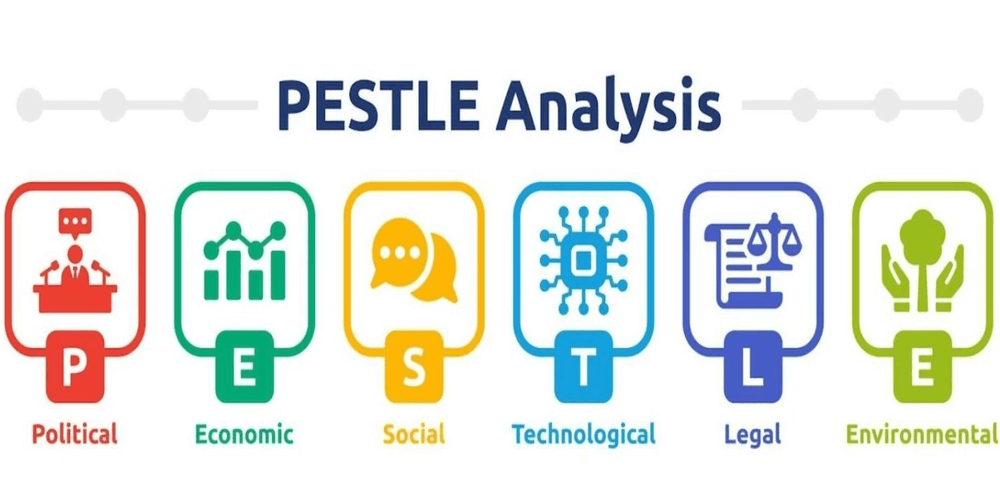
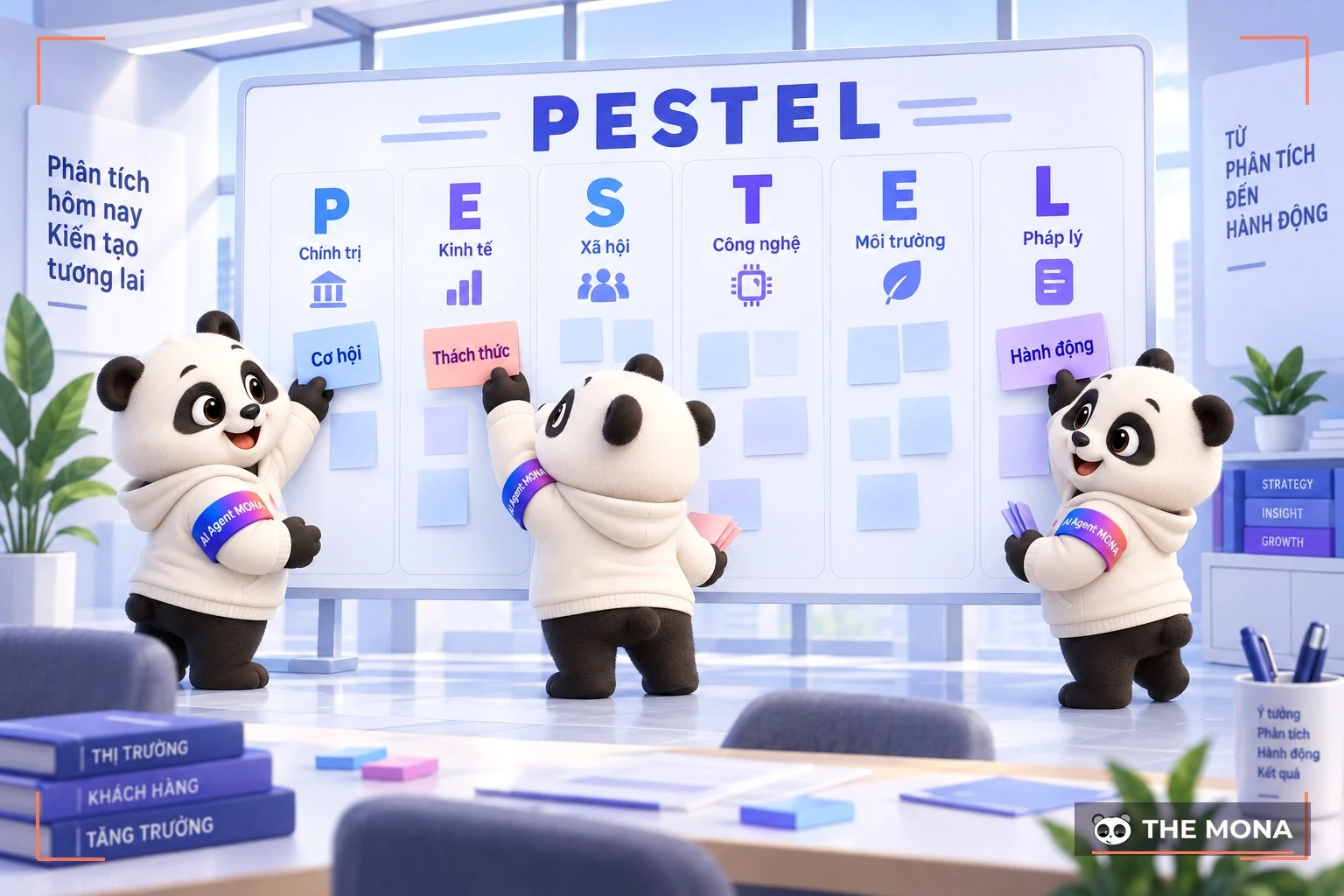
The PESTEL model includes the following factors: Economic, Political, Social, Technological, Environmental and Legal.
Political factor
The political factor of the PESTLE model covers influences on an organization's operations that come from politics and from the laws and policies of the government and other political bodies. Political factors in PESTLE can affect an organization's business and operations. They therefore need to be assessed and managed carefully to get the best results.

Economic factor
The economic factor in the PESTEL model involves analyzing economic conditions and market trends . These economic factors are analyzed to assess their effect on the business. Market analysis of the economy in the PESTEL model helps a business make strategic decisions that fit the current and future economy.
Social factor
The social factor in the PESTEL model covers the analysis of factors that affect the society and culture of the market. It is one of the key factors for identifying social and cultural changes and trends in the market. Analyzing the social factor helps a business make decisions and adjust its strategy to fit society.
Technological factor
The technological factor in the PESTLE model covers influences on an organization's operations that come from technology development and new applications of technology. Technological factors in PESTLE can include technology development, technological change and competition, and issues related to security and privacy. -> See also: Optimizing website security
Environmental factor
The environmental factor covers environmental issues and environmental protection as they relate to an organization or a particular market. Analyzing the environmental factor in the PESTEL model helps a business understand environmental factors and how they may affect its operations. From there, the business can make suitable decisions to respond to specific environmental issues.
Legal factor
The legal factor in the PESTEL model covers the analysis of legal factors, regulations and laws that a company must comply with when doing business in the market. It is one of the key factors for assessing how laws and regulation affect an organization's operations.
How to carry out a PESTEL analysis
PESTEL analysis is an important tool for assessing the environment an organization operates in and shaping its business strategy. Below are the steps for carrying out a PESTEL analysis:
Step 1: Collect information from different sources, including books, newspapers, government websites, industry reports and interviews with industry experts.
Step 2: Information that is unimportant or duplicated can be removed so you can focus on the key factors.
Step 3: At this stage, assess the PESTEL factors accurately and completely, so you have full and accurate information about the organization's operating environment.
Step 4: Based on the assessment of the PESTEL factors, identify the opportunities and challenges related to the organization's operations. Opportunities are factors that can help the organization develop and grow. Challenges are factors that can affect the organization's operations.
Step 5: Based on the analysis and the opportunities and challenges you identified, set strategies and action plans to expand the opportunities and deal with the challenges. These strategies must fit the objectives and the PESTEL factors.
Applying the PESTEL model in business
Some applications of the PESTEL model in business are as follows:
Marketing planning: When the PESTEL model is applied to marketing plan, a business gets an overall view of the market and the environment it operates in. From there it can assess and choose an approach and strategy that fit that market and environment.
Business strategy: PESTEL helps a business understand more deeply the environment and the factors that affect its operations. Applying the PESTEL model in business strategy helps the business assess and choose an approach and strategy that fit its operating environment.
Product development: Product development is also an important application of the PESTEL model. When a business applies PESTEL to product development, it can assess and decide on product development that fits its operating environment. This improves its competitiveness in the market and meets consumer demand.
Changing the organizational structure: The PESTEL model gives an organization a clear view of the external factors that may affect changes to its structure. Using this reference, managers can act on the key factors and make sound decisions to adjust the organizational structure.
What to do when a PESTEL analysis does not give the result you want
When a PESTEL analysis does not give the result you want, a business can take the following steps to adjust:
Research the PESTEL factors further: The business can research more and reassess the PESTEL factors to see more clearly how they affect its operations.
Change the analysis method: If the original method is not effective, the business can change method or use other tools and methods to carry out the PESTEL analysis.
Form hypotheses for each factor: The business can form a hypothesis for each PESTEL factor and run tests to check it.
Discuss with and consult experts: The business can seek opinions from experts on PESTLE factors and analysis methods to learn about other solutions.
Go back and reassess the strategy and plan: If the issues above cannot be resolved, the business can go back and review its strategy and plan to make sure they fit its operating environment and the market.
Organizations that use the PESTEL model
The PESTEL model can be applied in many areas of life. In health, for example, PESTEL assesses the effect of government health policies, the state of the economy, market trends and demand, environmental issues and health-related regulations. Organizations that have applied the PESTEL model include Uber, Coca-Cola, Nike, Adidas and Apple. The case of Adidas applying PESTLE:
Political: Adidas has run into many issues such as war, nationalization, tax systems, terrorism and expropriation. These cost the company money and time and delayed product deliveries to customers.
Economic: In 2005 the company faced several economic setbacks driven by inflation, unemployment, taxes and an unstable stock market. These cut customers' purchasing power significantly, and Adidas's revenue fell.
Social: Adidas designs meet the needs and trends of users of every age, culture and religion. The company focuses on people who love movement and sport.
Technology: Adidas applies its own inventions and technology to its products, which sets it apart from competitors. It uses its website to promote its name and products around the world, and consumers, whether they exercise or not, know the quality of Adidas products.
The environment: The company works to limit emissions and manage its output of organic compounds. It makes durable, long-lasting products, so customers trust their quality, and the Adidas brand image grows stronger.
Legal: Adidas is a highly reputable brand with global reach, trusted by customers everywhere. The company keeps working to stay legally compliant in every country to protect its brand value.
FAQ
What are the benefits of using the PESTEL model?
Using PESTEL helps a business understand its external environment better and shape a suitable strategy. It gives an overview of the influencing factors and helps spot new opportunities and respond to risks and environmental changes.
What are the drawbacks of PESTLE?
Although PESTEL is a useful tool, it has some drawbacks. It focuses only on the external environment and may not fully assess the effect of factors inside the business. In addition, an analysis with this model can become too broad and complex, requiring a lot of time and resources. That is the basic information about Pestel and applying the PESTEL model in business. Each PESTEL factor addresses a different aspect of the business environment. We hope this article helps you when planning for your company or organization. See also:
The PESTEL model has 6 factors: Political, Economic, Social, Technological, Environmental and Legal. Each factor reflects a group of external forces that can affect an organization's operations and strategy.
What is the PESTEL model used for in business?
The PESTEL model is used for marketing planning, business strategy and product development. Specifically, it helps an organization assess the opportunities and challenges coming from the external environment, so it can make decisions and set a strategic direction that fit.
About The MONA Group: Founded in 2016, with 60+ staff, MONA has delivered 14,000+ projects with an 85% client retention rate. MONA provides website design, full-scope SEO, custom software and AI automation solutions for businesses. Consultation hotline: 1900 636 648. Explore MONA AI Agent suite and MONA SEO services.
MONA has a podcast: listen instead of readingEpisodes on AI, automation & SEO for Vietnamese businesses
Founder of The MONA, who built a services company of 60+ staff with 14,000+ projects delivered. Khánh Hùng shares how he thinks about building systems that run themselves, automating a business, and the real lessons from delivering projects at MONA.
Own a website with a beautiful, 100% exclusive design and a lifetime warranty, with the ability
to expand features flexibly as your business grows, starting today!