
 MONA OS 2.0
 Partner with MONA


 Tự động hoá doanh nghiệp
 Cẩm nang SEO
 Digital Marketing
 Kinh nghiệm thiết kế website
 Hạ Tầng Server
 Giáo dục


 VI
 EN













Message us on
Zalo Official


 ProductsNew

 ProductsProducts
 Mới ra mắtKHA AI 2027App tự edit video, tự đăng mọi mạng xã hội, 2 phút mỗi ngày










 Website designLooks good and wins customers over.
SEO servicesBrings in customers searching for exactly what you sell.
 Tư vấn digital marketingKéo khách từ nhiều kênh, đo bằng số thật.
Corporate video productionVideos introducing your company, factory and team.
 NewAI video productionCompany story films made with AI.
 Custom software developmentCRM, ERP and HRM built for your business.
 Viết AI Agent theo yêu cầuĐặt riêng một trợ lý AI cho đúng việc của mình.
 Tư vấn chuyển đổi AIĐưa AI vào vận hành của cả công ty.
NewMONA LMSManagement for centers and schools.
MONA SkillHubInternal training for company staff.
 NHTQ systemEnd-to-end China–Vietnam shipping operations.
MONA JMSManagement for gold, diamond and pawn shops.
 MONA E-LearningA website with every feature you need to sell courses.
 How to sell online courses (course)More than 30 free lessons on selling courses on autopilot.
 MONA Cloudmonacloud.vnServers to get your apps and websites running.
 MONA Basemonabase.vnPostgres database, sign-in and file storage.
 MONA Mailmonamail.vnSend OTP, order and invoice emails from your software.
 MONA Paymonapay.vnAccept bank transfers via VietQR and notify your software when the money arrives.
 MONA eInvoiceComing soonIssue e-invoices that meet tax standards.
Gấu CườiTrả lời khách 24/7 trên web, Fanpage, Zalo và thu lead cho sale.
 Gấu TeleSalesGọi điện tư vấn, chăm khách như tổng đài viên thật.
Dê CườiTư vấn và chốt đơn cho shop ngay trong khung chat.
Gấu WebmasterNhắn nhóm Zalo là website được sửa xong.
 Gấu Pháp ChếSoạn hợp đồng, rà điều khoản trong vài phút.
 Gấu Báo GiáLên báo giá đúng mẫu và gửi khách ngay.
 AI chăm sóc khách hàngTheo dõi và giữ chân khách hàng cũ.
 Gấu Tuyển DụngLọc hồ sơ, hẹn lịch, phỏng vấn ứng viên.
 Mới ra mắt
KHA AI 2027
Xây kênh chuyên gia 2 phút mỗi ngày
Quay bằng điện thoại, AI tự edit video, tự đăng lên 16 nền tảng và tự trả lời bình luận, tin nhắn.
895.025lượt xem trên kênh CEO MONA sau 37 ngày
 Anh Khánh HùngCEO MONA đang dùng mỗi ngày
Xem app làm được gì
 AI
Gấu Cười MONA ĐANG TỰ XÀITrả lời khách 24/7 trên website, Zalo OA, Messenger và thu lead về cho sale.
Dê CườiChốt đơn bán lẻ và sàn: Shopee, TikTok Shop, web. Chăm cả khách sỉ, đại lý.
Gấu WebmasterCập nhật nội dung, tối ưu SEO website mỗi ngày.
Gấu TeleSalesGọi điện tư vấn, chăm khách như tổng đài viên thật.
Gấu Tuyển DụngLọc hồ sơ, hẹn lịch, phỏng vấn ứng viên tự động.
AI chăm sóc khách hàngGiữ khách cũ, cứu lead đã rớt cho phòng kinh doanh.
Gấu Pháp ChếSoạn hợp đồng, rà điều khoản trong vài phút.
Gấu Báo GiáLên báo giá đúng mẫu, gửi khách ngay khi có yêu cầu.
 Chuyển đổi AI toàn phầnGiải pháp tổng cho doanh nghiệp, 3 lớp triển khai.
 Viết AI Agent theo yêu cầuĐặt riêng một con AI gánh đúng nghiệp vụ của bạn.
 Custom softwareCRM, ERP and HRM with built-in AI automation.
 SEO & AEO thời đại AIĐược Google lẫn AI trích dẫn, không chỉ xếp hạng.
 Kiến thức AI cho doanh nghiệpBài phân tích, hướng dẫn ứng dụng AI vào vận hành.
 Free AI courses
 AI tools at work
App mới · KHA AI 2027
Xây kênh 2 phút mỗi ngày
AI tự edit video, tự đăng mọi mạng xã hội
Free consultation, 8am–10pm every day

14 June, 2026

This article is for business owners who already know what E-E-A-T is and now want to know what to do differently now that AI answers in place of search engines. If you need the full definition of the four letters, we have a separate article: What is E-E-A-T in SEO. Here we go straight to the four signals machines can read, with fresh survey data and a list of mistakes Vietnamese businesses often make without realizing it.
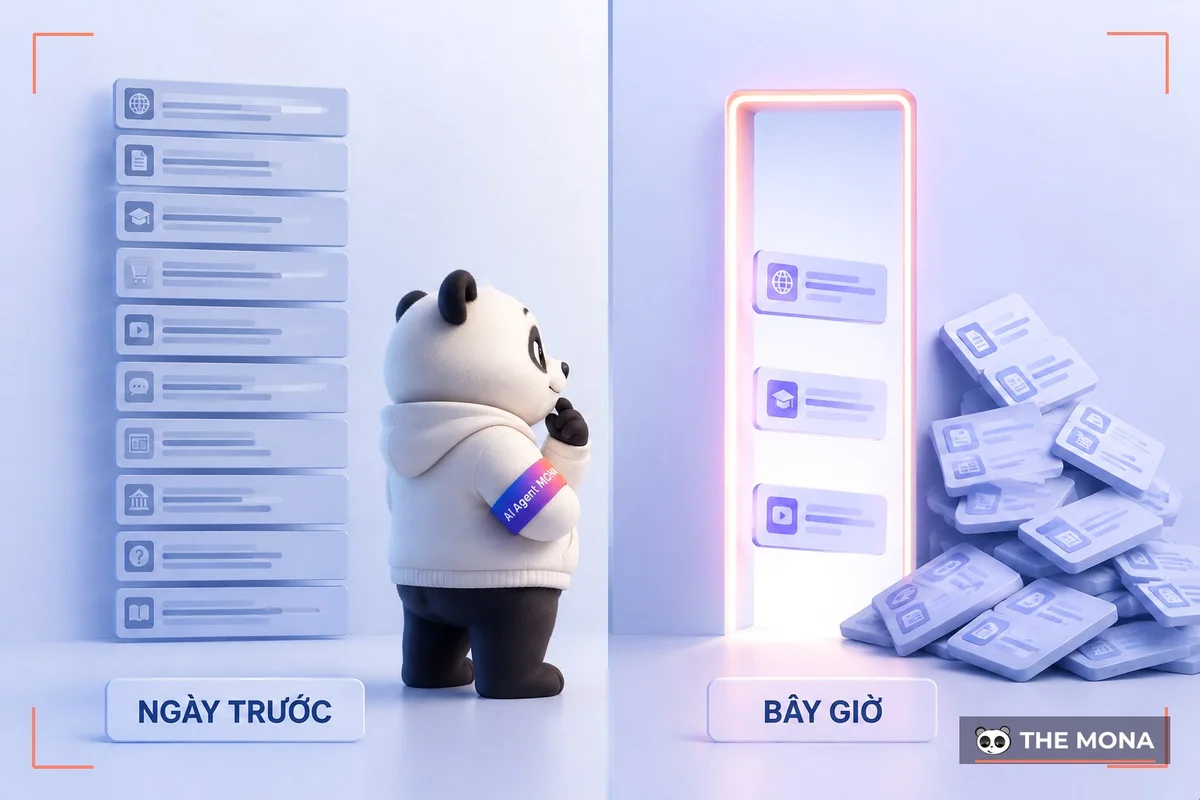
Three years ago, a good article in eighth place on page one still earned readers, because users scanned all ten results before choosing. Now it's very different. When Google answers with AI Overviews, or when a customer types a question straight into ChatGPT, the machine has to pick two to five sources to build the answer. Eighth place effectively doesn't exist.
That is the whole new pressure. Ranking used to be a ladder: slip a few rungs and you lost some customers, not all of them. Now it's closer to a door: either your name is in the answer or it isn't, with no middle step. Readers see only the sources the machine picked, and most of them don't click further. We analyze this in detail in the article What is Zero-Click Search.
This needs spelling out because the Vietnamese SEO market is selling it wrong. E-E-A-T lives in the Search Quality Rater Guidelines, the handbook for Google's human quality raters, with the current version released in September 2025. Google doesn't assign any page an E-E-A-T score. That number doesn't exist in the system.
Here's how it really works: raters read a page and score its quality against the E-E-A-T framework, those ratings are used to train and calibrate the algorithms, and then the algorithms look for technical signals that correlate with human judgment. So E-E-A-T describes the target, and what you can adjust are the signals underneath. Anyone selling you a package to "raise your E-E-A-T score to 90" is selling a number that doesn't exist, because Google's systems have no data field by that name. What the SEO market is selling and how the profession is changing, we cover plainly in the article the SEO profession in 2026.
We go into this because it changes how you work. Chasing a made-up score gets you nowhere: every month the report says "E-E-A-T improved" and nobody can say by how much. Chasing real signals is countable: how many articles now have a real author name, how many author pages declare schema, how many places still have inconsistent business information. The four signals are in the lower part of this article, and for each one we state how to check it.
With the old search engine, the algorithm ranked ten results and let the user choose. A small mistake didn't matter, because the reader made up for it. With AI, the machine has to commit. It puts a source's name in the answer and takes responsibility for that content. A model caught citing junk sources loses credibility immediately, so every vendor has tightened source selection far more than ranking ever was.
The consequence for businesses is a bit harsh. Accurate content published anonymously on a website nobody knows gets skipped by the machine. Equivalent content published under a person with a clear profile, on a domain that industry press has mentioned, gets picked. The quality of the writing is the same on both sides, and the result is different. We break down how machines expand one question into many sub-queries and then gather sources in the article What is Query Fan-Out.
In this section we give the numbers first and the commentary after, so you can check them against the marketing budget you're spending. Ahrefs analyzed 75,000 brands, measured each brand's visibility on ChatGPT, AI Mode and AI Overviews, and then computed rank correlations with familiar metrics. The full version is in the study of 75,000 brands published December 12, 2025, and we pulled out the three numbers most worth remembering.
A weak correlation doesn't mean backlinks are useless, and we're not saying that. Backlinks still help your domain clear the minimum bar to get into the pool of sources the machine draws from. Below that bar, you're not in the game. But once you're past it, piling on more backlinks doesn't do much, while each time an industry news site or a professional forum mentions your name, the lift is clearer.
This runs against how the market spends. Many businesses pay by the number of backlinks per month, measured in an Excel sheet, ignoring entirely whether anyone mentions them anywhere. An industry article that names your company, your field and your area correctly, even with no link, still teaches the machine that your company exists and what it does. That is something bulk-bought backlinks can't buy.
The 0.737 figure for YouTube startled us a little the first time we read it, but on reflection it makes sense. A YouTube video has auto captions, a description and comments, and all of it is text a machine can read. A 15-minute talk by your technical director about exactly what your company does produces roughly 2,000 to 2,500 words of captions with context, plus the speaker's face and real name, which packs both Experience and Expertise into one piece of work.
We're not telling you to drop text SEO and make videos. The point is that if your budget is all going to one place, split it. For most service businesses, one 10 to 15 minute video a month about the craft, even shot on a phone, with the speaker's name and job title, already beats thirty hastily bought backlinks.
Test one question in 5 minutes
Open ChatGPT or Google AI Mode and type exactly the question your customers ask before buying, with your city or province. See whose name the machine mentions. If it names three competitors and not you, it's usually not because your content is bad. Most of the time the machine can't find enough signals to trust you. Take a screenshot of that answer and send it to us via 1900 636 648, and we'll check which signals are missing, free of charge.
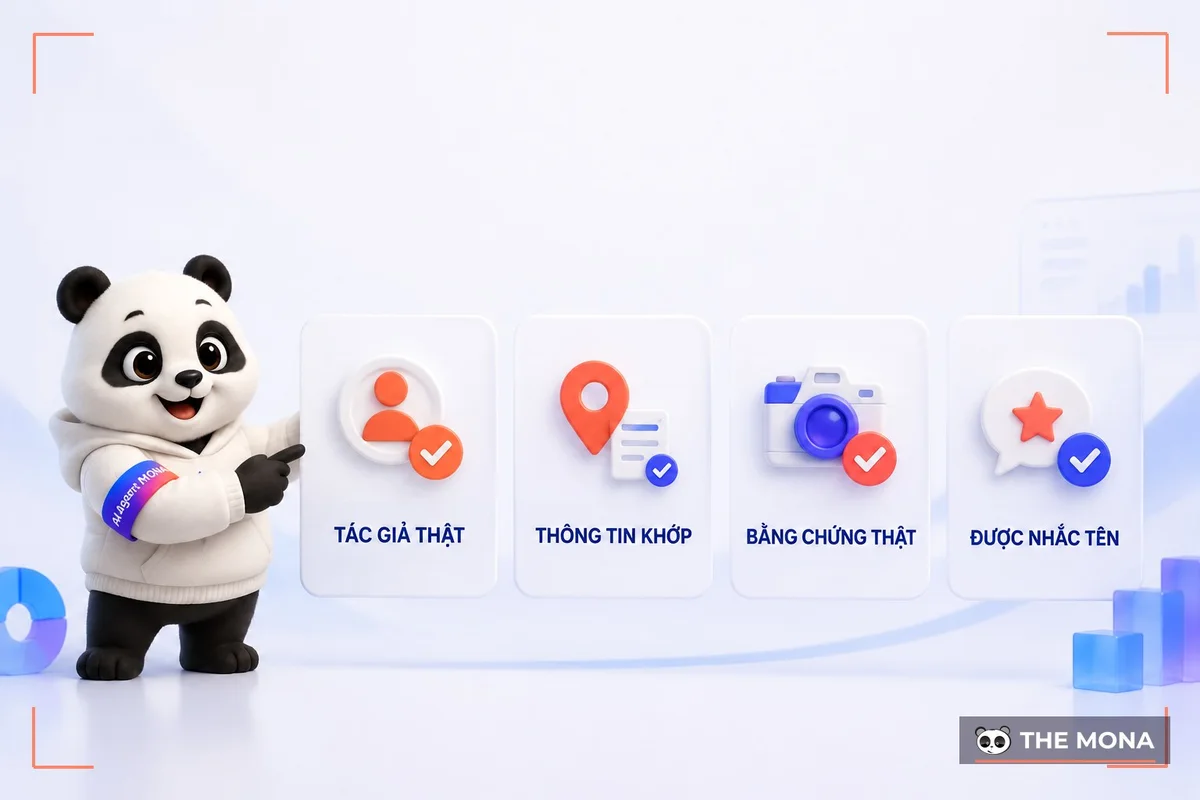
The four items below are real technical signals, each checkable by eye in about 10 minutes. We've ordered them by what to do first, with cheap and fast work at the top.
The first E is Experience, and a machine only recognizes experience when it knows who went through it. A post under an "Admin" account has nobody behind it. This mistake is so common that when we take over an old website, the first thing we do is open the post list and count how many posts are under "Admin" or "Editorial team". The answer is usually all of them.
There are three parts to the fix. One, every article has a real author name with a job title and years in the trade, not a shared pen name from the marketing department. Two, every author has their own profile page on the website that says clearly what they've done, where and on which projects, and that page must declare Person schema with the property sameAs pointing to that person's real LinkedIn or Facebook. Three, the name and photo on the website must match the name and photo on those profiles. One character off and the machine treats them as two people.
The sameAs is what links a name to an entity in the machine's knowledge graph. We explain the entity mechanism separately in the article What is SEO entity.
The T, Trustworthiness, is measured by machines with a crude but effective test: they gather your business's name, address and phone number from every place they find it and check whether they match. A mismatch costs you trust.
The list of places that must match is usually longer than you think: the website footer, the contact page, the Organization schema, your Google Business Profile, your Facebook page, industry directories, e-invoices. The address is the most common mismatch, because each marketing push has someone writing it differently: one place says "Q.1", another says "Quận 1", another uses the new ward name after the merger. A machine reads those three spellings as three different locations. Going through and making them all match usually takes an afternoon, and it's the cheapest job in this entire article.
Alongside this group are some small things that carry real weight: an unexpired SSL certificate, privacy policy and terms pages that are actually written rather than copied from a template, a public tax code, and an About page with photos of the real team instead of stock photos. Machines spot stock photos instantly, because the same image sits on thousands of other websites.
This is what separates a practitioner's article from one written by someone who searched Google and rewrote it. Evidence of experience includes photos taken at your own workplace, before-and-after measurements, specific dates, software version names, click paths in order, and what real people said, kept in quotation marks.
A test we often use when reviewing an article before it goes live: remove every brand name from the piece and reread it from the top to see whether you can still tell who wrote it. If you can't, the article has no experience in it, only information. Machines have already swallowed billions of words of information. What they lack is what you did yesterday, at your place, with a specific number.
How you present it matters too. The answer should sit right at the top of a section rather than in the fourth paragraph, because machines cut paragraphs when they cite. We cover that in the article writing answer-first content, and the markup that machines read in the article what is Schema.
The A, Authoritativeness, is not something you declare on your own website. It's what other people say about you elsewhere, and machines gather those places.
Four mention sources worth pursuing, ordered by how easy they are. First, industry press and specialist sites: one interview or one expert quote from your company is enough. Second, forums and professional groups, where your staff answer real questions with real accounts. Third, profiles on industry rankings and directories, which many people skip because they think they are outdated, but machines still read them. Incidentally, the machine-readable markup work also includes file llms.txt, which takes about an hour; we file it under doing it for completeness, so don't expect much. Fourth is video, exactly as the YouTube data above shows.
What to avoid is buying fake reviews. Thirty five-star reviews in the same voice, bunched into three days, are obvious to people and machines alike, and they drag the T down faster than having no reviews at all.
We run into the six mistakes below again and again when taking over old websites. None needs a developer to fix.
Together, these six mistakes explain quite a few cases of well-written websites that AI still doesn't mention. The content is good, but the outer shell has no information, so the machine has nothing to hang its trust on. Fixing all six on a website of about 200 posts takes roughly two to three weeks, and most of it is labor rather than money.
Every industry has one kind of evidence that pays off far more than the rest. Do that one first.
If the website is slow or has no security certificate, everything above loses points. We handle that foundation in website design service and infrastructure Mona.Host.
Four tasks, in order, about one working day in total, and no waiting on anyone to approve a budget.
Task one: open ChatGPT, type exactly the question your customers ask, and write down the names it mentions. That is your current scoreboard. Task two: go into your website, count how many posts are published under "Admin", and switch them to a real person's name with a job title. Task three: type your company name into Google and compare the address and phone number in the first five places you find; fix any that don't match. Task four: schedule a short video for this month, shot by a real practitioner in your company, talking about exactly what they do every day.
Do those four first, then think about spending money outside, and when you divide the budget, look at how to split your SEO budget sensibly. Measure again after three months using the metric set in the article measuring SEO as zero-click grows, and stop measuring by keyword ranking.
A real story from MONA
Great content with an empty shell still gets skipped by machines
About 0.66 to 0.71 for brand mentions, set next to 0.266 for Domain Rating, says one simple thing: the money you're pouring into backlinks is buying the wrong thing. Meanwhile, the four signals above, from a real author name to matching business information, mostly cost effort rather than money.
We review E-E-A-T for business websites: checking author pages, entity schema, how consistent your business information is across platforms, and then returning a task list in the order to do them, with a time estimate for each. For anything you can do yourself, we say so plainly.
Call 1900 636 648 during business hours, or leave your domain at contact page. If you need the whole package, see SEO services and the MONA AI Agent suite.

CEO & Founder · The MONA
Founder of The MONA, who built a services company of 60+ staff with 14,000+ projects delivered. Khánh Hùng shares how he thinks about building systems that run themselves, automating a business, and the real lessons from delivering projects at MONA.
 297




Professional website
design services
Own a website with a beautiful, 100% exclusive design and a lifetime warranty, with the ability
to expand features flexibly as your business grows, starting today!






 MONA will never sell your information or send you spam


 MONA will never sell your information or send you spam
